










 Deutsch
 Français
 Italiano
 Español
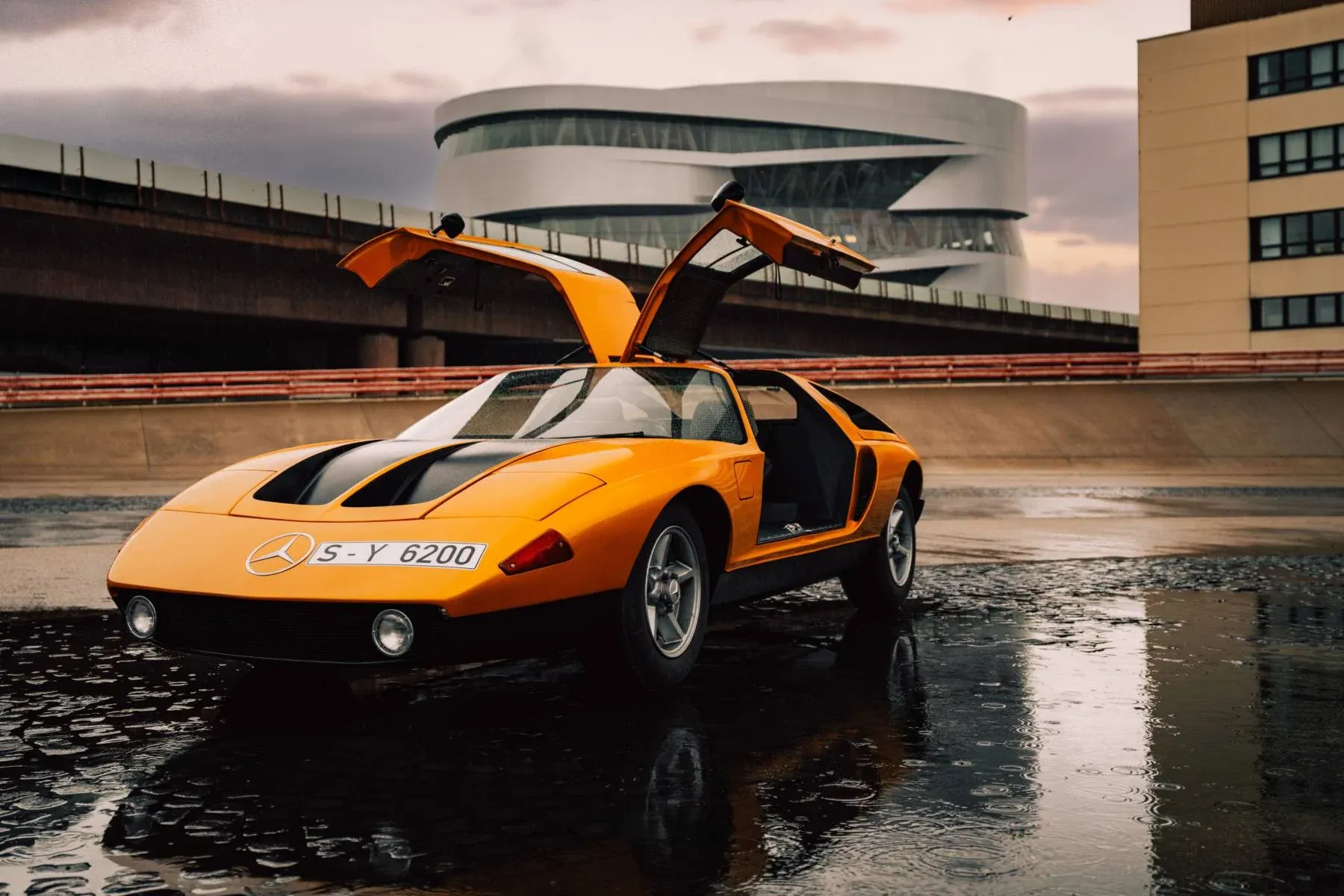
Mercedes-Benz has never sold a C 111. On 3 February 2027, at the Palais du Louvre in Paris during Rétromobile, RM Sotheby's will offer one: C 111-II “Wagen 33”, the third C 111-II built, returned to running order in 2024 and showing 24,766 km. The auction house states a value in excess of €25 million. Mercedes has published no figure, has committed not to sell another C 111 for at least 25 years, and will put the proceeds into its Mercedes-Benz Museum 2.0 project.
The C 111-II “Wagen 33” in detail
Why has Mercedes never sold a C 111?
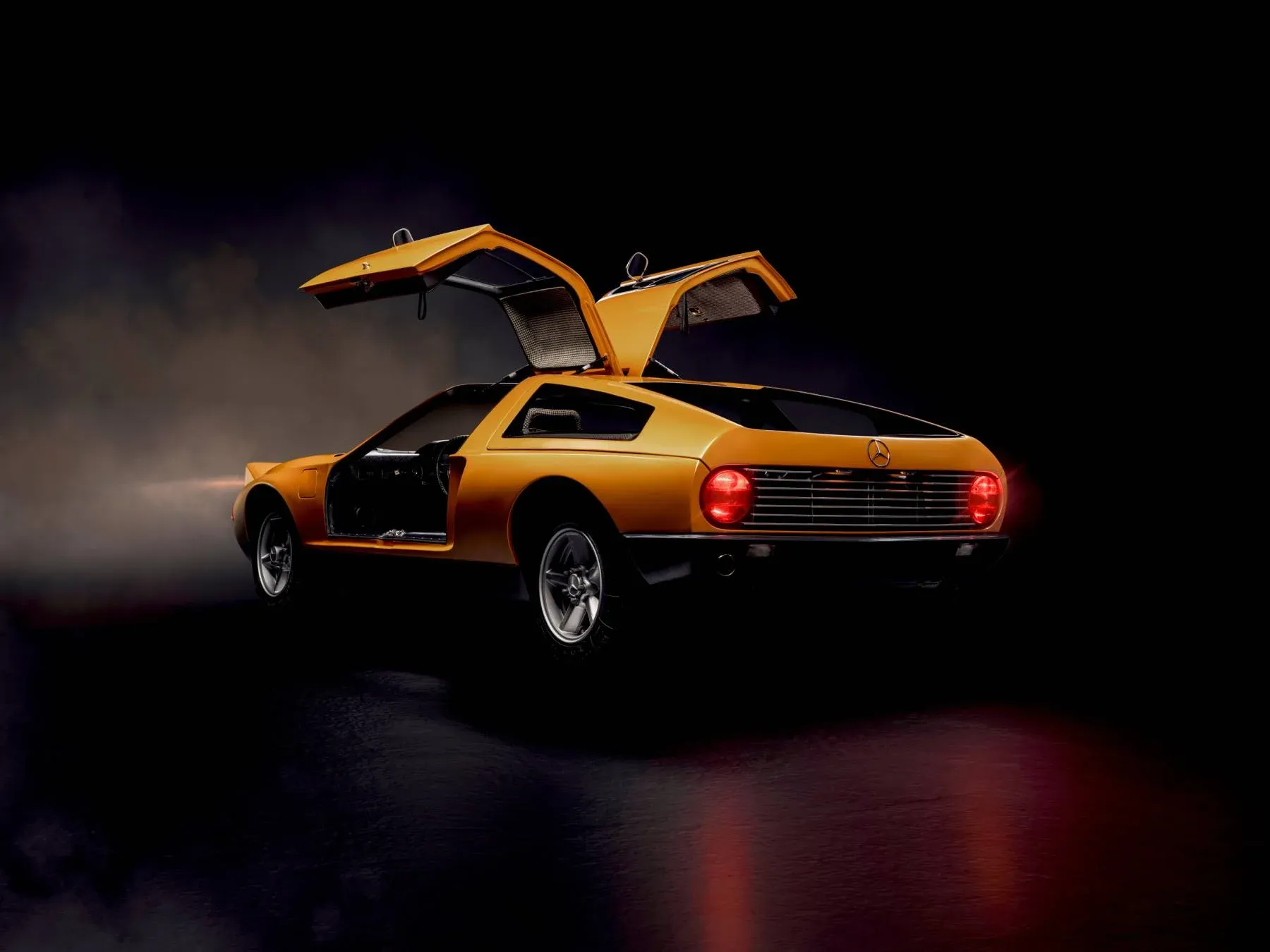
The first C 111 appeared at the Frankfurt IAA in September 1969: a mid-engined two-seater with a glass-fibre-reinforced plastic body, gullwing doors that pointed back to the 300 SL, and a Wankel rotary engine. It was the first show car Mercedes had ever built, and according to the RM Sotheby's catalogue the company stated in a press release the following month that it was not for sale. Offers arrived anyway, some of them as blank cheques.
Six months later the C 111-II arrived at the 1970 Geneva Motor Show with a four-rotor engine and a reworked body. The board studied what a limited production run might look like, then decided in November 1971 that there would be no series production. Mercedes today cites emissions standards, costs and the 1973 oil crisis. The catalogue adds that the development department had counted 38 present or future American regulations the car could not meet, and that the design was built so tightly around the compact rotary engine that a conventional one would have meant starting again.
Seventeen C 111s were built in all, from the rotary prototypes to the later diesel and V8 record cars. None has ever left the company's ownership. That is the fact this sale changes.
Which C 111 is Wagen 33?
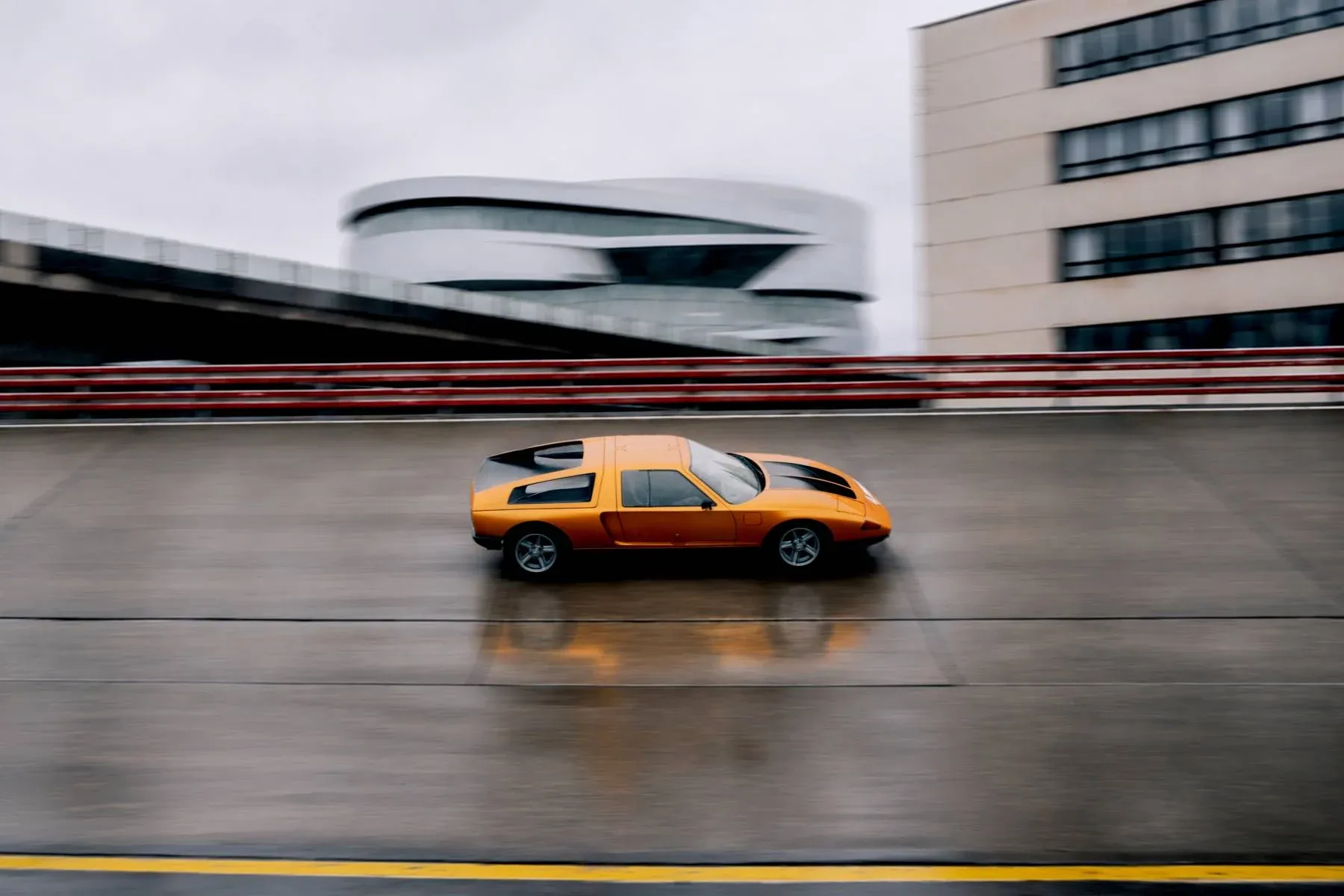
Wagen 33 is the internal number of the third C 111-II. Its chassis was assembled at Sindelfingen in March 1970, the glass-fibre body was completed by Waggonfabrik Rastatt in May, and the car returned to Sindelfingen in June for paint and trim: Weißherbst orange outside, grey and white houndstooth inside. It only received its engine, the four-rotor M 950 with Bosch mechanical direct injection, in August 1970, when it was registered S-Y 6200 and joined the experimental fleet.
Its working life was short and specific. The car proved the fluidic system that drained the sill-mounted fuel tanks evenly, ran Uhlenhaut's butter test in December 1970 and had its last official session at the Hockenheimring in August 1971, alongside Wagens 25, 31 and 34. Mercedes also lists 116-litre side tanks, temperature measurements and an early ABS installation, now inactive. In April 1971 it served as the demonstrator for the conductor Herbert von Karajan, and in August 1972 it appeared in the first German edition of Playboy.
In September 1975 the car moved into the company collection. It spent the following decades on loan to exhibitions, then stood from 2006 to January 2024 in the Fascination of Design area of the Mercedes-Benz Museum in Stuttgart, until Wagen 32, the Geneva show car with a dummy engine, took its place.
Four rotors and 350 PS: the period figures
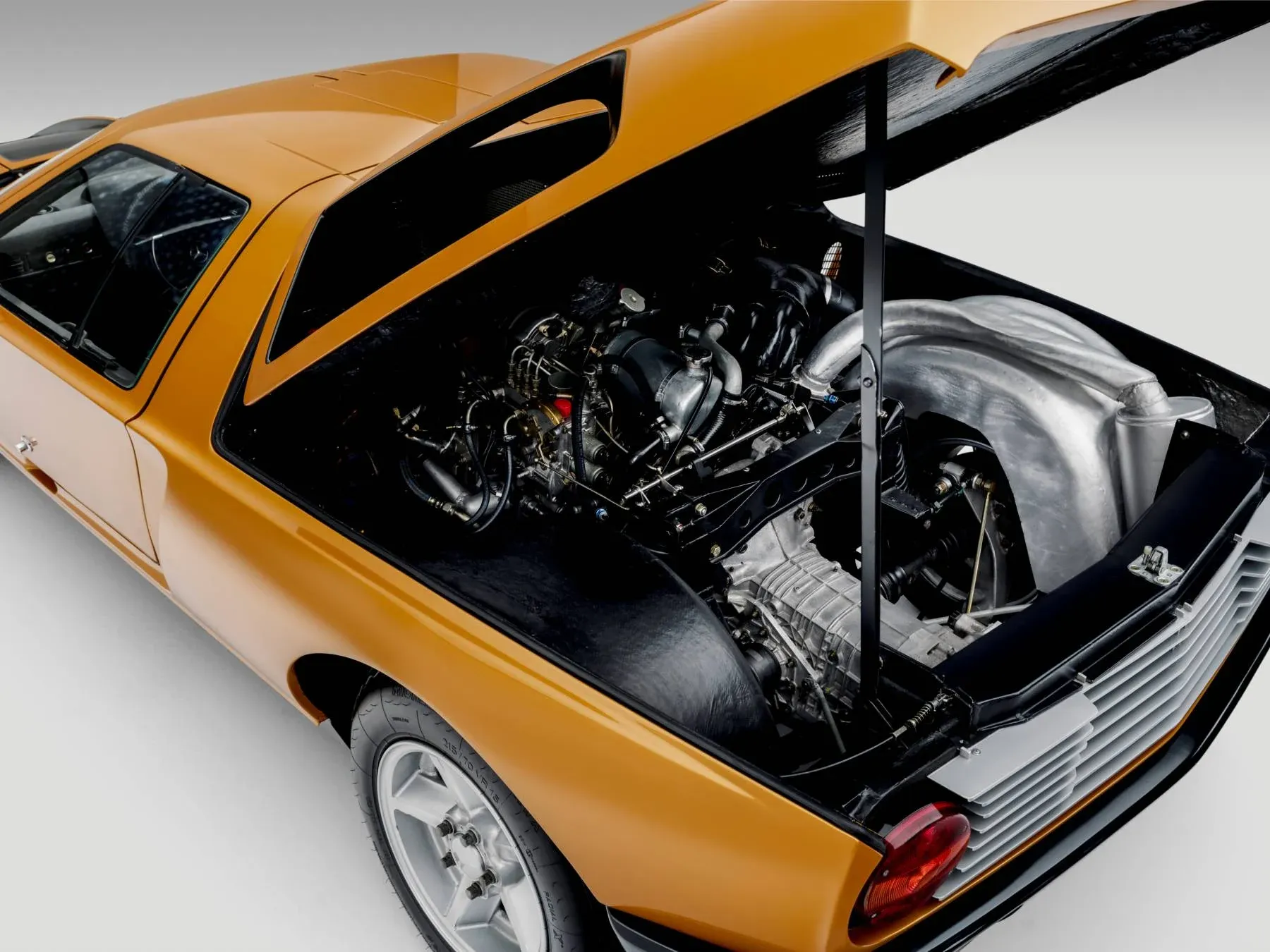
The M 950 W 48 has four rotors and a displacement of 2.4 litres, which Mercedes equates to 4.8 litres in a piston engine. It produces 257 kW (350 PS) at 7,700 rpm and 392 Nm between 4,000 and 5,500 rpm, with a 9.3:1 compression ratio. The engine alone weighs 217 kg. RM Sotheby's gives a 9,000 rpm redline and a five-speed ZF transaxle.
The performance figures are those of the period: 0 to 100 km/h in 4.8 seconds, a top speed of 300 km/h and a kerb weight of 1,240 kg. The catalogue places the output in the territory of the Ferrari 365 GTB/4 Daytona and the Lamborghini Miura, both V12s, with a top speed nearly 20 km/h higher. These are manufacturer and auction-house claims from more than fifty years ago, not measurements taken on this car today.
The car comes with its 8 x 15-inch road wheels and its magnesium racing wheels in 10 x 15 and 13 x 15 inches. Mercedes specifies that the magnesium rims are now for display only.
In what condition does the car arrive in Paris?
In 2024 the Mercedes-Benz Classic Center in Fellbach went through the car ahead of the Pebble Beach Concours that August. Mercedes says the original patina was kept, the powertrain fully overhauled and a fire-suppression system fitted. According to the catalogue, it was the first time in more than twenty years that the Wankel engine had been started.
At Pebble Beach, Wagen 33 drove the Tour d'Elegance and was shown, unjudged as is customary for factory collection cars, in the class for wedge-shaped concepts and prototypes. Mercedes then displayed it on its stand at Rétromobile in February 2025. The odometer read 24,766 km when it was catalogued in October 2026.
How much could the C 111-II sell for?
Mercedes' press release gives no estimate. The RM Sotheby's lot page does: “Value in excess of €25,000,000”, displayed alongside $27.5 million, £21 million and CHF 23 million. That is a floor stated by the auction house, not a price. The result could land well above it, or the car could fail to reach a reserve that has not been disclosed.
The conditions are unusual too. Internet bidding is not available for this lot, and terms apply beyond those of the Paris auction: prospective bidders must register and be approved in advance, then bid in the room or by telephone. That limits the field to a small number of identified buyers, which is what one expects at this level.
Measured against what Mercedes has sold before, €25 million sits far below the only precedent and far above anything the brand's supercars fetch on the open market. Both ends are worth a closer look.
The precedent: the Uhlenhaut Coupé at €135 million
In May 2022, Mercedes-Benz and RM Sotheby's sold one of the two 300 SLR Uhlenhaut Coupés at an invitation-only auction held in the Mercedes-Benz Museum. The price, €135 million, set a record for a car at auction. The proceeds created a Mercedes-Benz Fund for scholarships in environmental science and decarbonisation, and the buyer agreed that the car would remain accessible for public display on special occasions.
The two sales share a method: the same auction house, a car from the company's own collection, a stated purpose for the money. The scarcity is not the same. Two Uhlenhaut Coupés were built and Mercedes kept the other one; thirteen C 111s remain in the factory fleet, eight of them C 111-IIs according to the catalogue's count of those built. The Uhlenhaut was derived from the 300 SLR racing car, while the C 111 is a research prototype that never raced. A result much closer to the floor than to the Uhlenhaut would therefore not be a disappointment, simply a different category.
What the 25-year commitment means for a buyer
Mercedes has committed by contract not to sell any other C 111 for at least 25 years. Of the 17 built, 13 remain in the company fleet; one was used for crash testing and three were dismantled in the 1970s. Once Wagen 33 is sold, the private market will hold exactly one C 111, and the only other source of supply is closed by contract until the early 2050s at the soonest.
For a collector, that clause does part of the valuation work. The risk when a manufacturer sells from its archive is that it might do so again and dilute the first sale; Mercedes has removed that risk for a generation. The commitment covers every C 111, including the C 111-II D diesel record car of 1976 and the C 111-IV of 1979, which set a lap record of 403.978 km/h at Nardò. Whoever buys Wagen 33 is buying the only one, for at least a quarter of a century.
Where the money goes: Mercedes-Benz Museum 2.0
The proceeds will finance the Mercedes-Benz Museum 2.0 project, which includes a digital twin of the Stuttgart museum built with The Classic Car Trust and its Roarington platform. Bettina Haussmann, head of the museum, says the first results should be visible in 2027.
That changes how the sale reads. The Uhlenhaut money went outside the company, to scholarships; this money stays with the heritage side of the business and goes into the building where Wagen 33 stood for eighteen years. Mercedes is selling one car from its collection to pay for the way it will show the rest.