







 Deutsch
  Français
  Italiano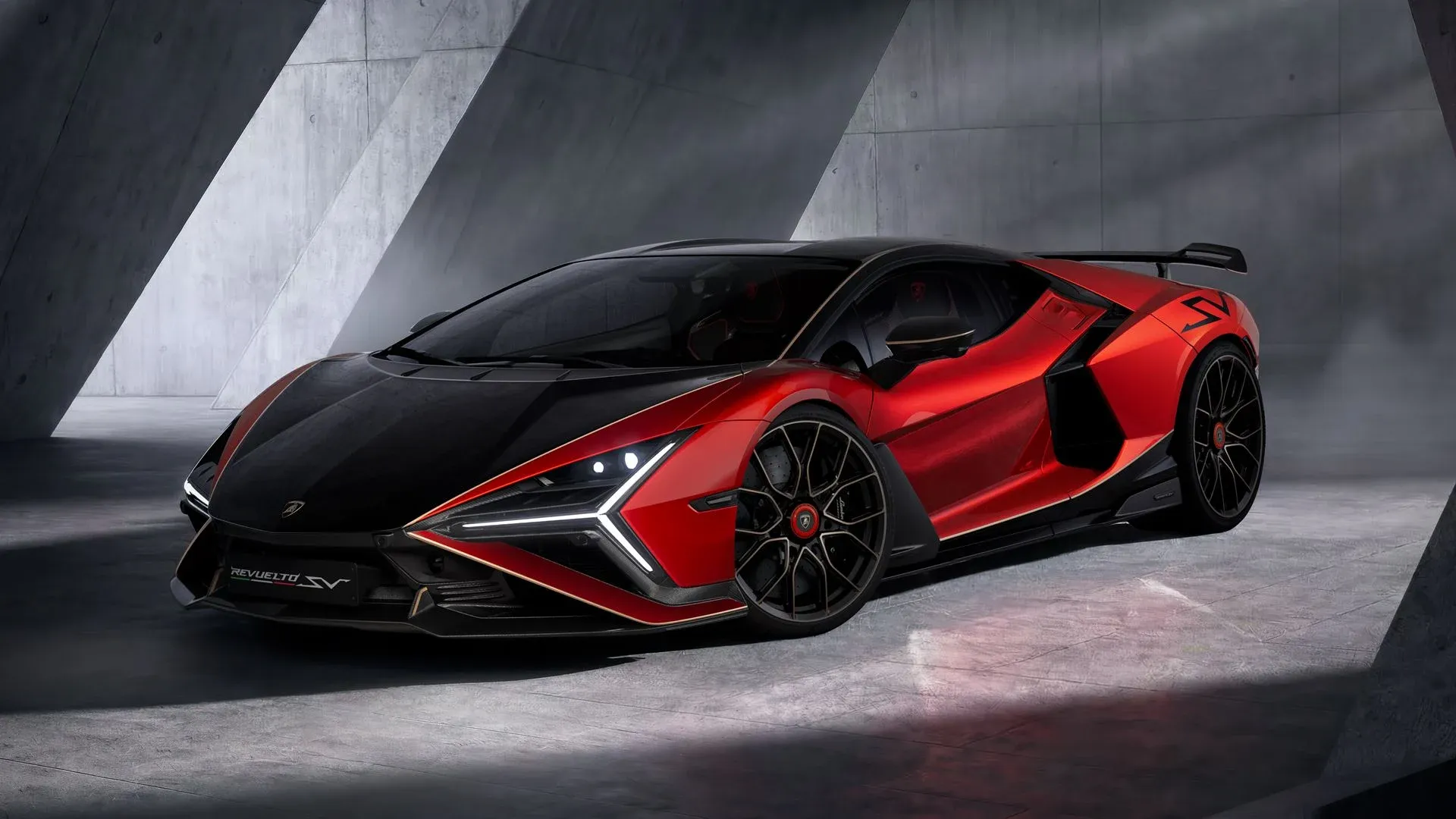
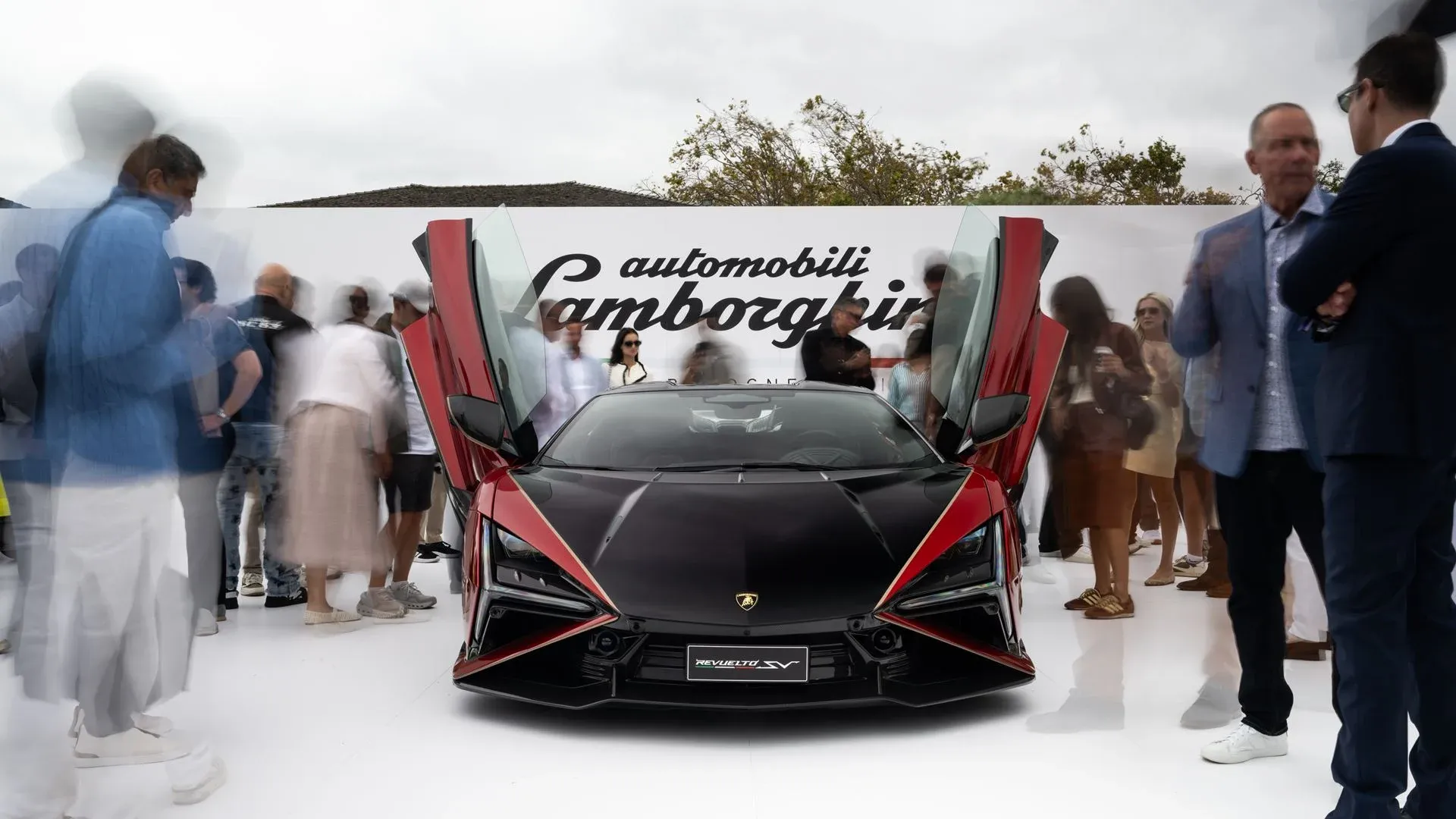
Lamborghini unveiled the Revuelto SV at The Quail, A Motorsports Gathering, on 14 August 2026. It is the fifth car to carry the Super Veloce name, it makes 1,065 CV where the Revuelto makes 1,015, and it will be built 1,963 times. The one number Lamborghini has not published is the price.
The Revuelto SV in detail
What the SV adds to the Revuelto
The mechanical layout is the Revuelto's: a 6.5-litre naturally aspirated V12 rated at 825 CV at 9,250 rpm, three electric motors, two on the front axle and one at the rear, and a 7.3 kWh lithium-ion battery able to deliver 190 kW. The system total is 1,065 CV and 1,425 Nm, fifty horsepower above the car it is based on.
Lamborghini quotes 2.4 seconds from 0 to 100 km/h, 6.7 seconds from 0 to 200 km/h, a top speed above 345 km/h and a power-to-weight ratio of 1.66 kg per CV. It also published a lap: 1:41.6 at the Hockenheimring, set by Marco Mapelli.
A published lap time is worth more than a top speed here, because it is the figure a manufacturer cannot round upwards without being contradicted the first time an owner takes the car to the same circuit.
The aerodynamics do more work than the extra fifty horsepower
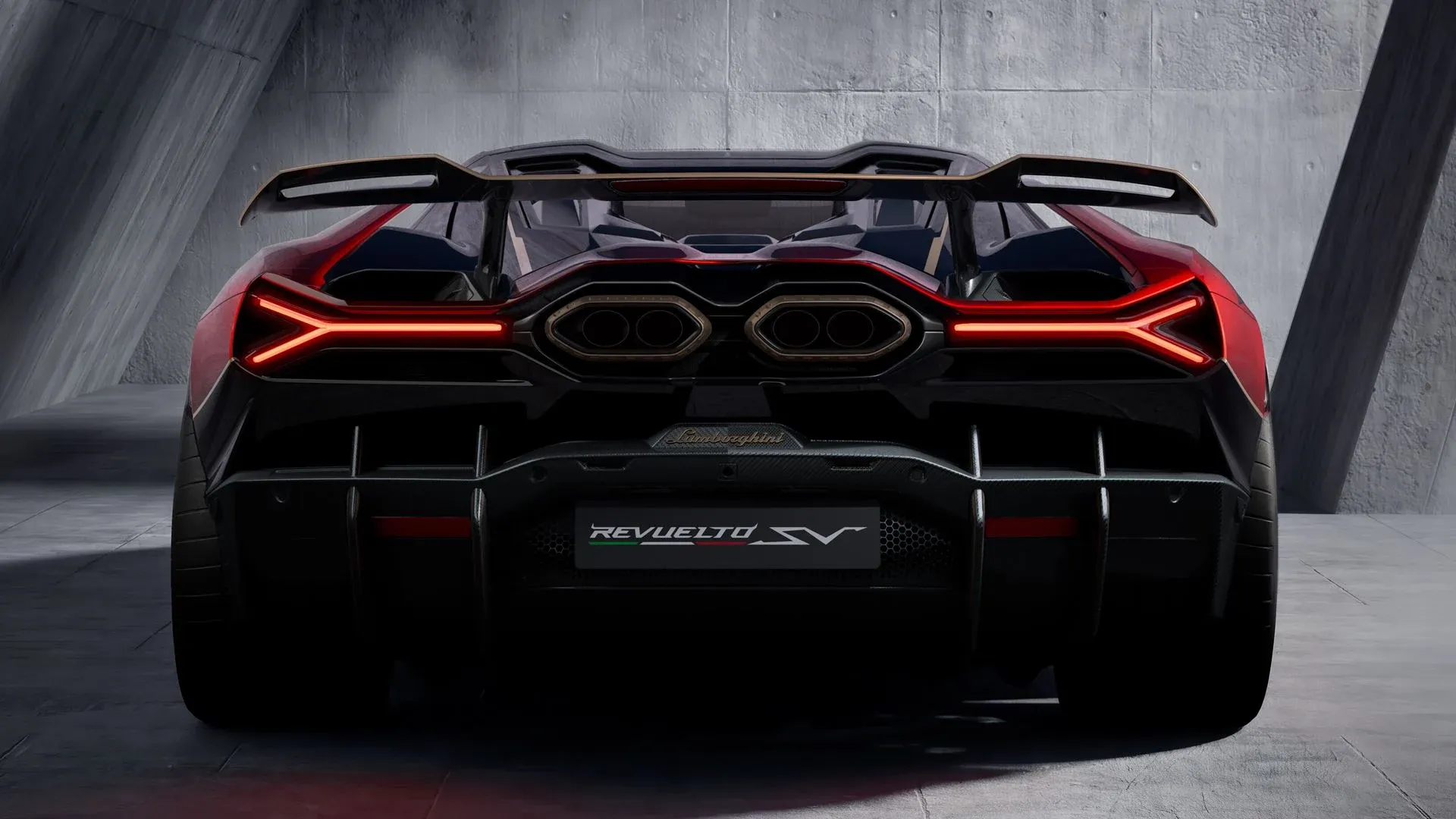
Fifty horsepower on 1,015 is a five per cent gain. The aerodynamic figures are of a different order: Lamborghini claims 80 per cent more downforce than the Revuelto and 10 per cent more than the Aventador SVJ, with a 60 per cent improvement in the downforce-to-drag ratio.
The braking package follows: CCM-R Plus carbon-ceramic discs of 420 by 40 mm at the front and 410 by 32 mm at the rear, 11 per cent more peak deceleration, 23 per cent better heat dissipation, disc temperatures 12 per cent lower, and 110 metres to stop from 200 km/h.
The suspension uses adjustable passive dampers derived from GT3 practice, credited with 17 per cent more agility and 10 per cent more lateral grip, on Bridgestone Potenza Race R semi-slick tyres that remain road legal. A new Pilota mode splits traction control into five stages.
The rest is detail work that adds up: new 3D-Superlight Dromos wheels with central locking, twenty inches at the front and twenty-one at the rear, an integrated brake control system reading vehicle dynamics through a 6D sensor, and up to twenty-five exterior components available in exposed carbon fibre for an owner willing to pay for the last kilogrammes.
Where the Super Veloce name comes from
Lamborghini traces the designation to the Miura SV of 1971 and names the Diablo SV of 1995 and the Aventador SV of 2015 as its successors. The Revuelto SV is the fifth car to carry it.
Stephan Winkelmann, chairman and chief executive, put it this way: "With the Revuelto SV, we continue that tradition by taking our V12 flagship to higher expression of performance and driving emotion."
The lineage is doing real work in the marketing, and it is fair to ask what it is worth. That question has an answer, because four of those five cars are on the market right now.
What the SV lineage costs today
On 28 August 2026, LUSSO lists 20 cars from the Super Veloce lineage across its dealers. Sixteen carry a published price; four are on application.
The oldest is also the dearest: a 1971 Miura S built to SV specification, offered in the United Kingdom at the equivalent of 2,339,916 euros. A 1997 Diablo SV, also in the United Kingdom, is at 760,486 euros.
The Aventador generation is where the volume sits. The SV LP 750-4 coupé runs from 422,139 to 643,434 euros, with two SV Roadsters at 455,156 and 590,000 euros. The SVJ runs from 487,202 to 818,868 euros, and the two SVJ Roadsters are the dearest of the modern group at 890,000 and 1,052,982 euros.
Two things follow from that spread. The badge does not carry a single value: both SVJ Roadsters are above 890,000 euros while no SVJ coupé on the list reaches 820,000, so the open car commands a premium that survives every other difference between the cars. And the Miura, at nearly three times the dearest Aventador, is priced as a historic car rather than as a fast one, which is what a fifty-five-year-old Super Veloce eventually becomes.
The Miura on the market is not a factory SV
The dearest car in that list deserves its own paragraph, because its description carries a distinction that decides the price. It is a 1971 Miura S built to SV specification, not a car that left Sant'Agata as an SV.
The conversion can be immaculate and the car can be worth every euro asked. It is still not the same object as a factory SV, and it should not be compared with one when a buyer is working out what the market says. The listing states the distinction plainly, which is what a listing should do; the mistake would be to read the price as a Miura SV benchmark.
It is the same discipline that separates a repainted car from a factory colour, or a rebuilt engine from a matching-numbers one. On cars at this level, the sentence in the description is worth more than the photograph.
What else Lamborghini brought to the lawn
The SV did not have the stand to itself. Lamborghini showed the Temerario Tricolore and the Urus SE Performante at the same event, the latter quoted at 3.3 seconds to 60 mph and 194 mph.
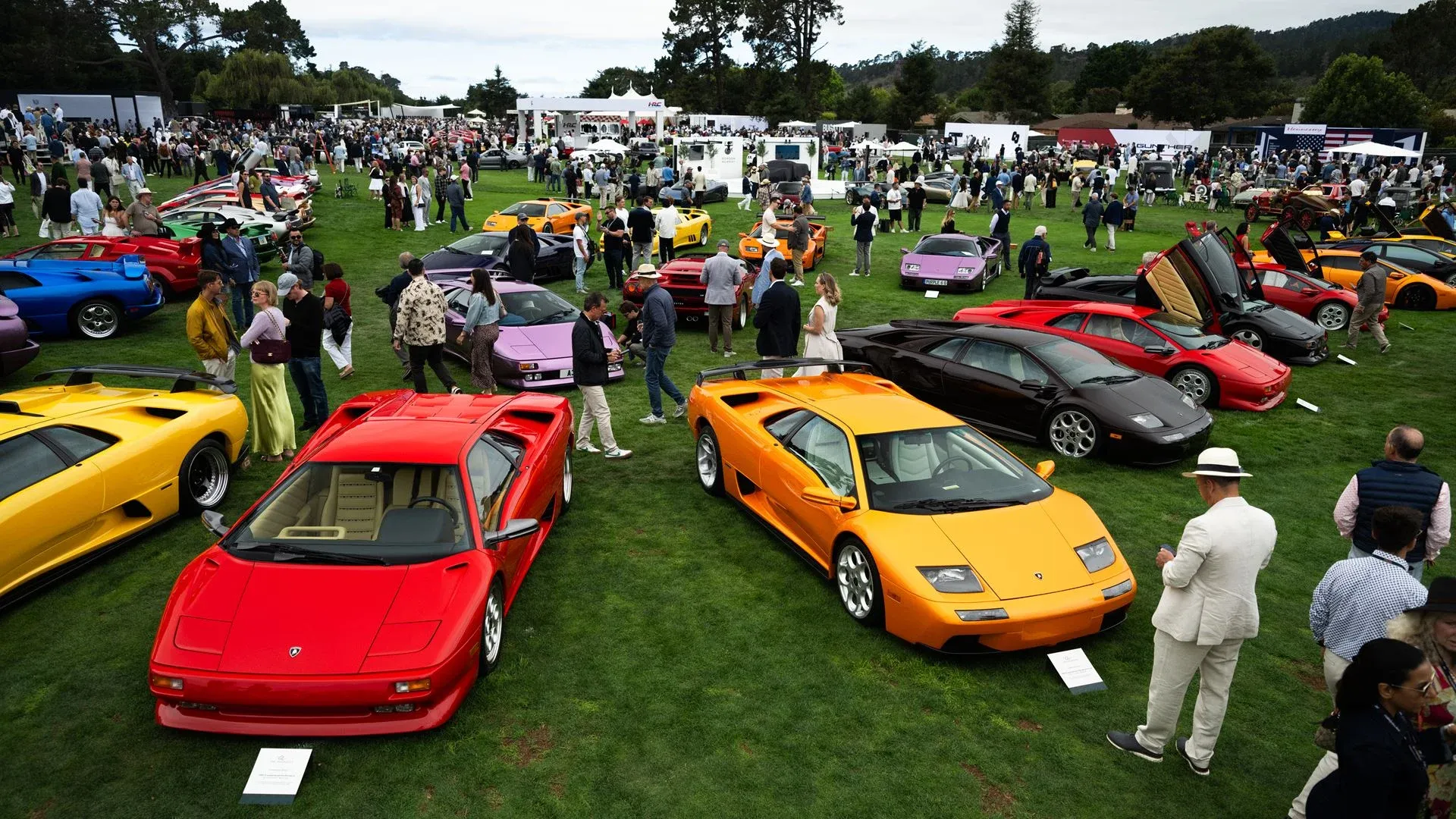
A few metres away sat the argument the SV name rests on: a lawn of Diablos and Countachs, the generation that made Super Veloce mean something before any of the modern cars existed. A launch staged next to its own ancestors is a choice, and it is the most persuasive part of the presentation.
Where these cars actually are
The twenty cars of the lineage are not in one market. They sit with dealers in the United Kingdom, Germany, Italy, the United Arab Emirates and Saudi Arabia, and that matters to the figure a buyer ends up paying.
A price seen from another country is not the price of the car. Import duty, VAT and registration change it, sometimes by more than the difference between two listings of the same model. The cheapest Aventador SV on the list, at 422,139 euros, is in the United Arab Emirates; a European buyer should compare it with a European car before concluding it is the bargain of the group.
The same caution applies to the figures in this article. They are asking prices published by dealers on 28 August 2026, converted to euros. They say what sellers want, not what buyers have paid.
How much does the Lamborghini Revuelto SV cost?
Lamborghini has not disclosed a price. The car was at type approval stage when it was shown and was not yet offered for sale, and neither press release carries a figure. Anything circulating is an estimate and should be read as one.
What can be said is where the base sits. LUSSO lists 52 Revuelto for sale on 28 August 2026, all with a published price, from 449,496 to 1,600,000 euros with a median of 564,500 euros. That top figure is not a list price: it is what a dealer asks for a car available now rather than in two years, and the gap between the two ends of that range is mostly delivery time and specification.
The SV will sit above that base, on an edition of 1,963 that is fixed in advance. Until Lamborghini publishes a figure, the honest answer to the question in this heading is that nobody outside Sant'Agata knows it.