








 Deutsch
  Français
  Italiano
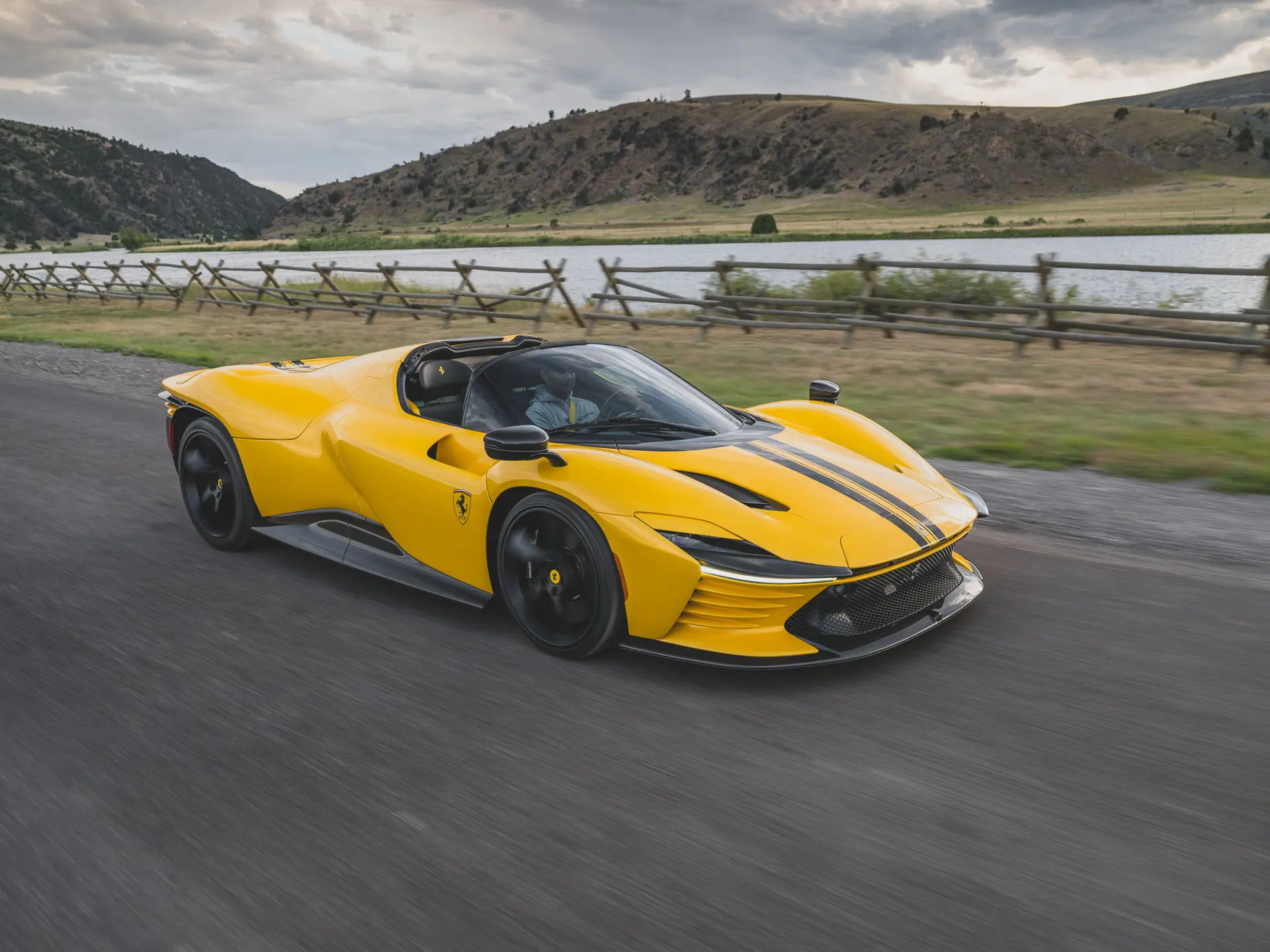
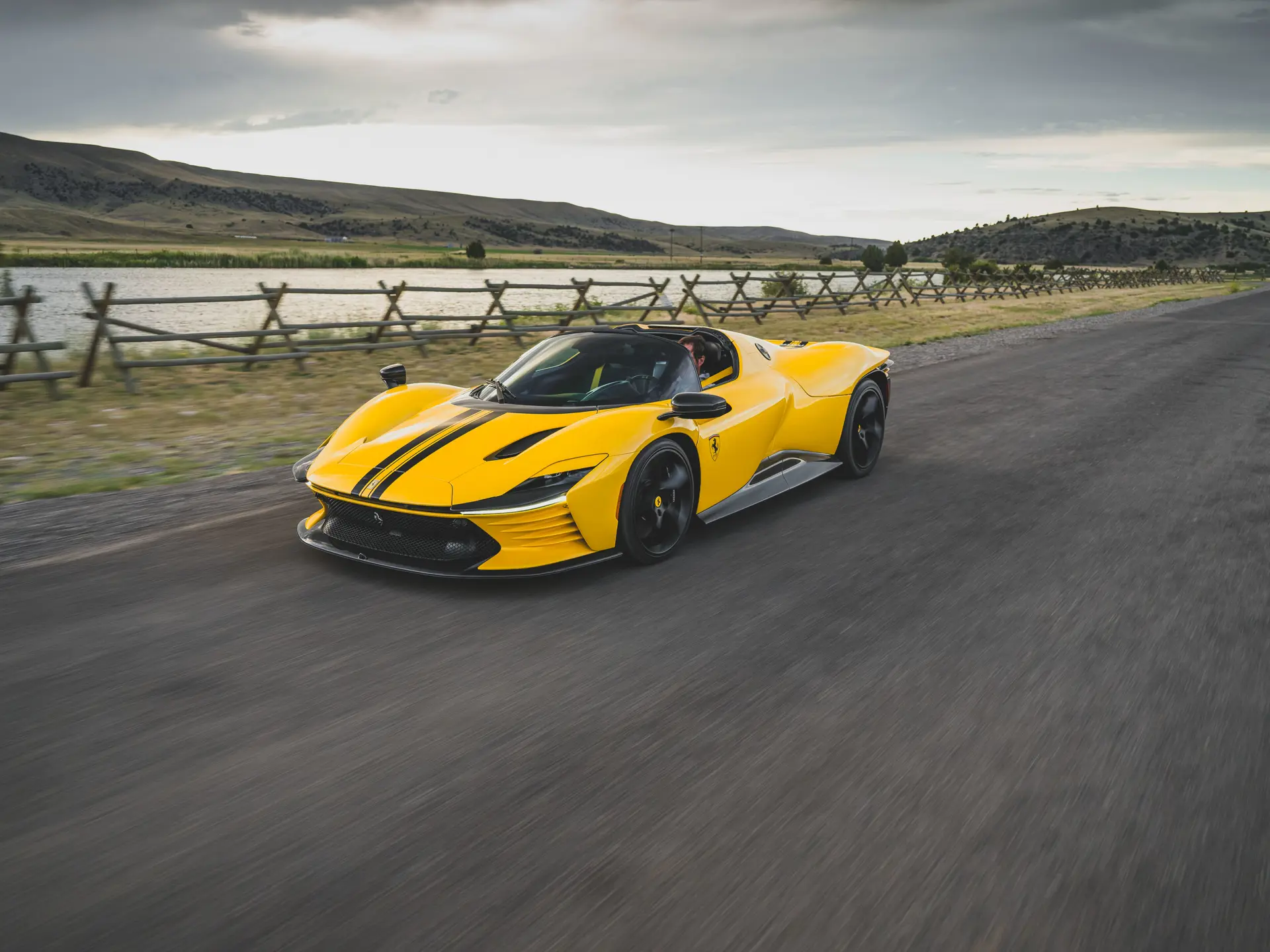
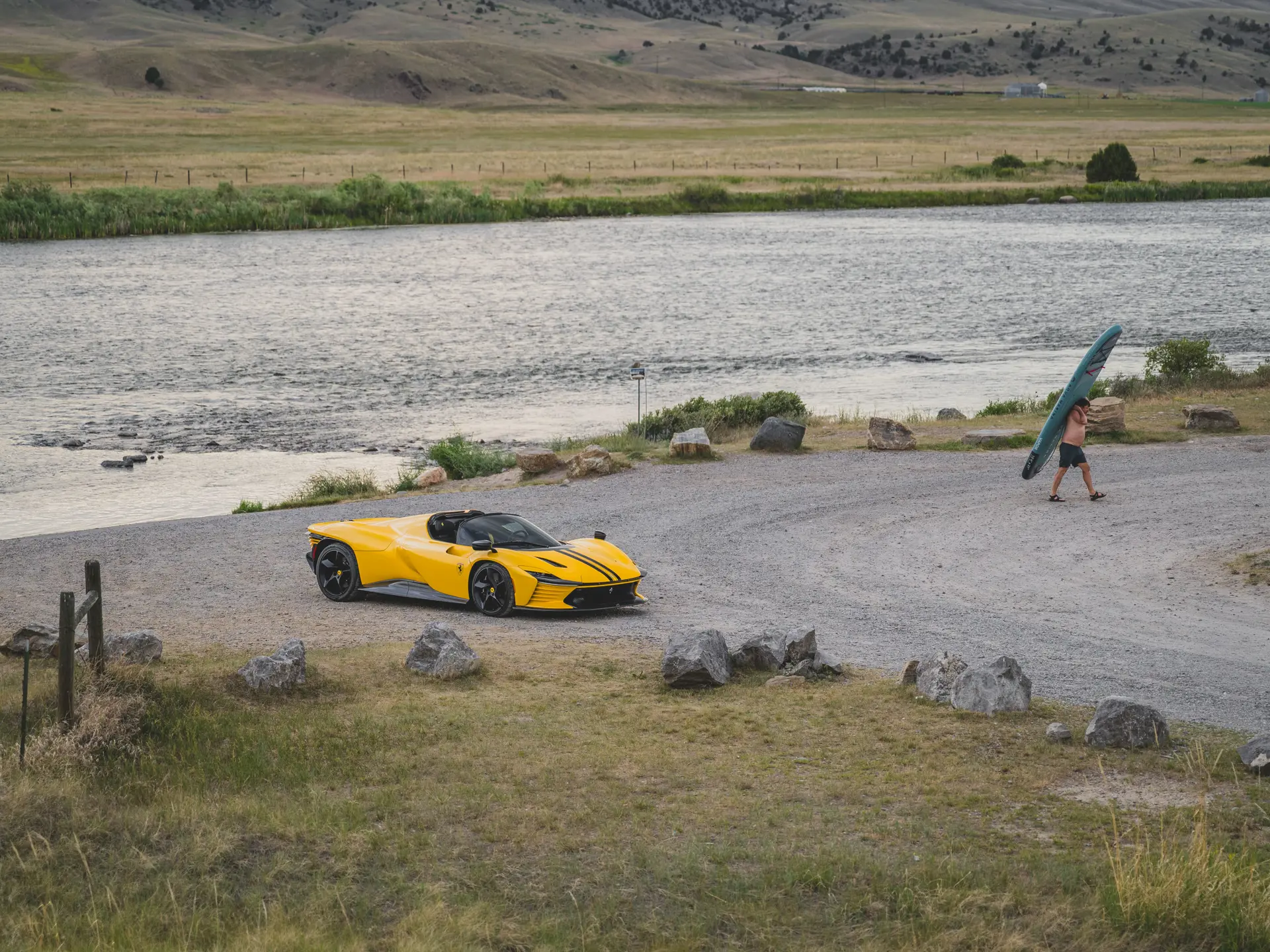
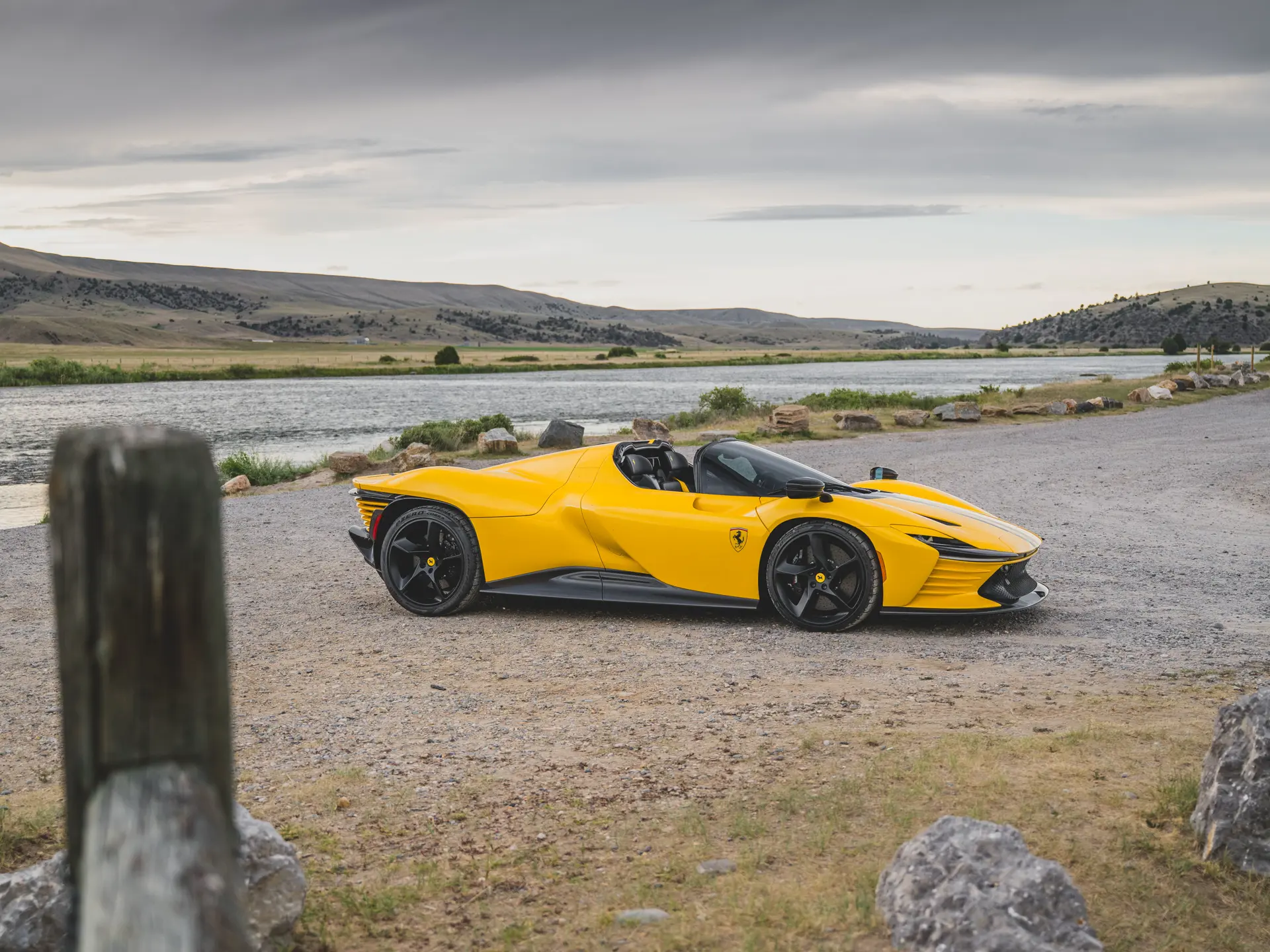
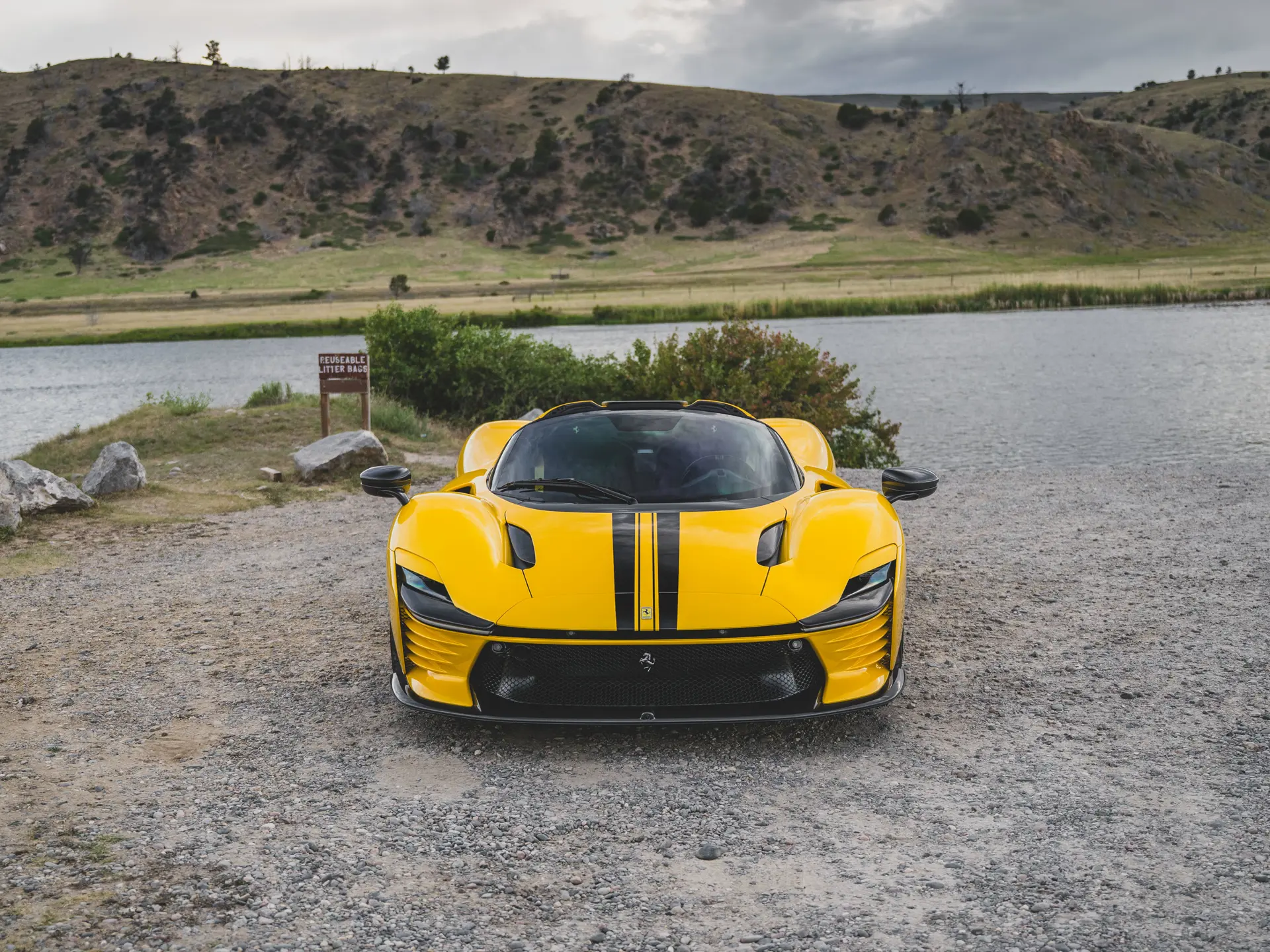
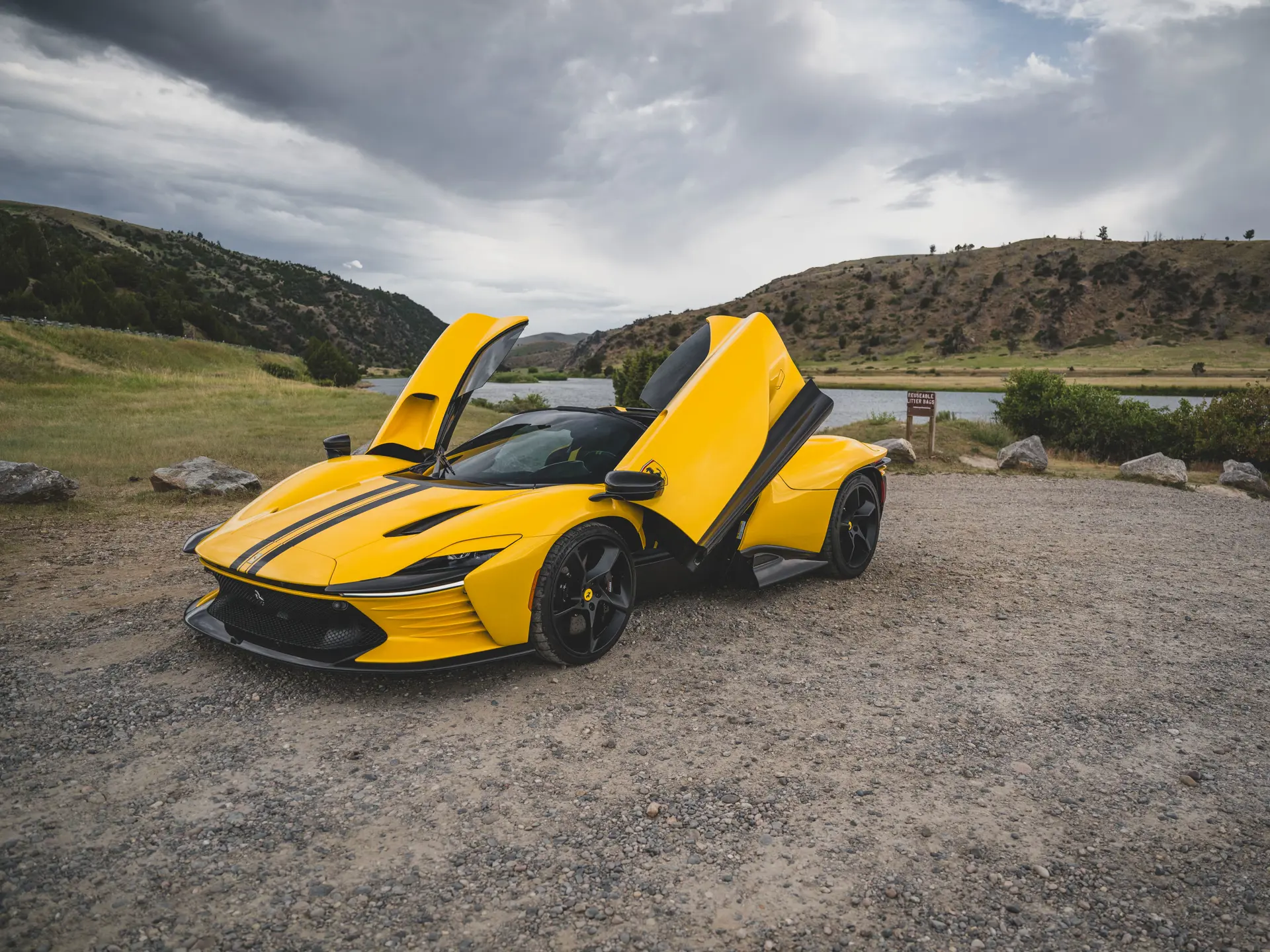
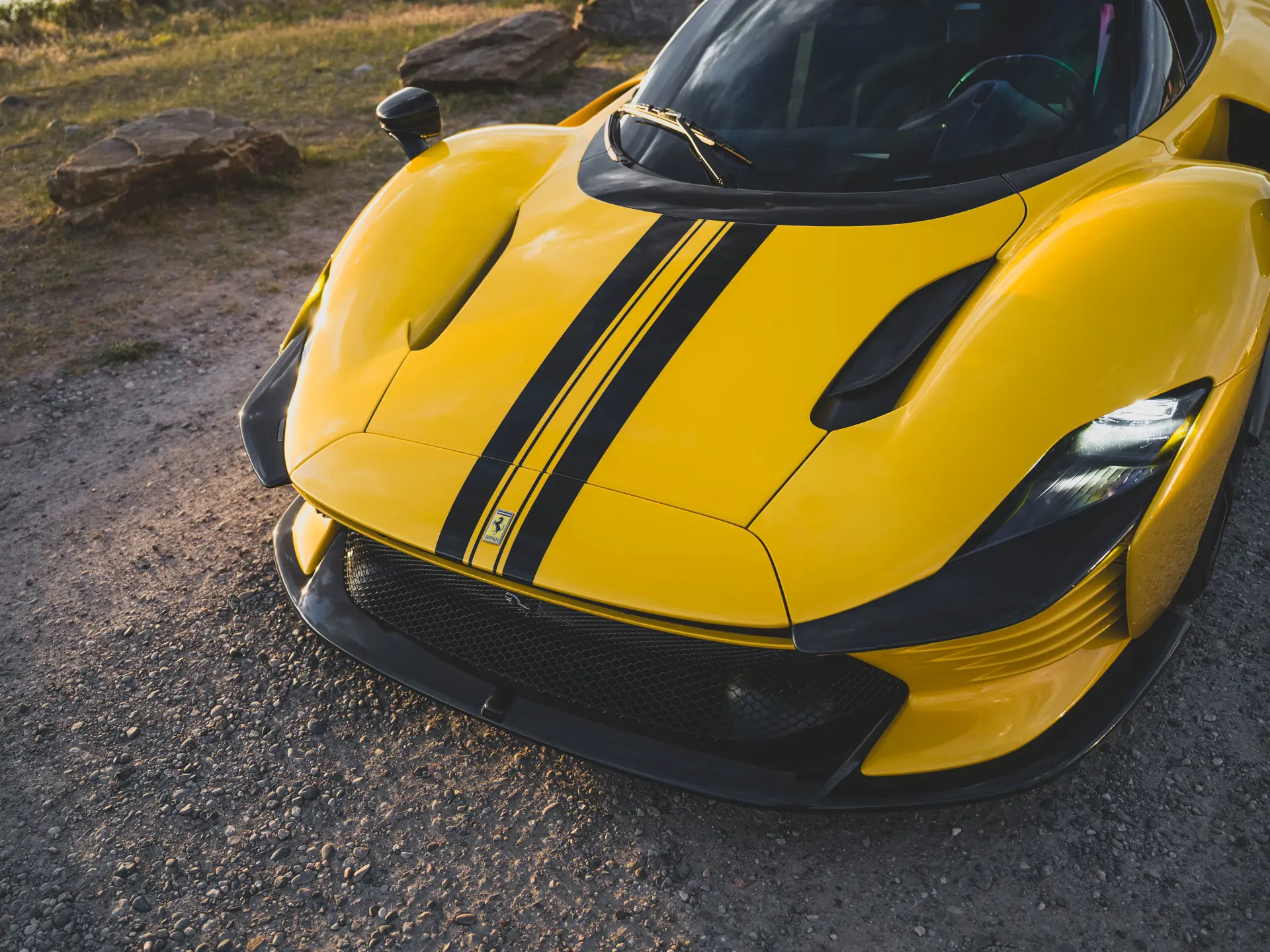
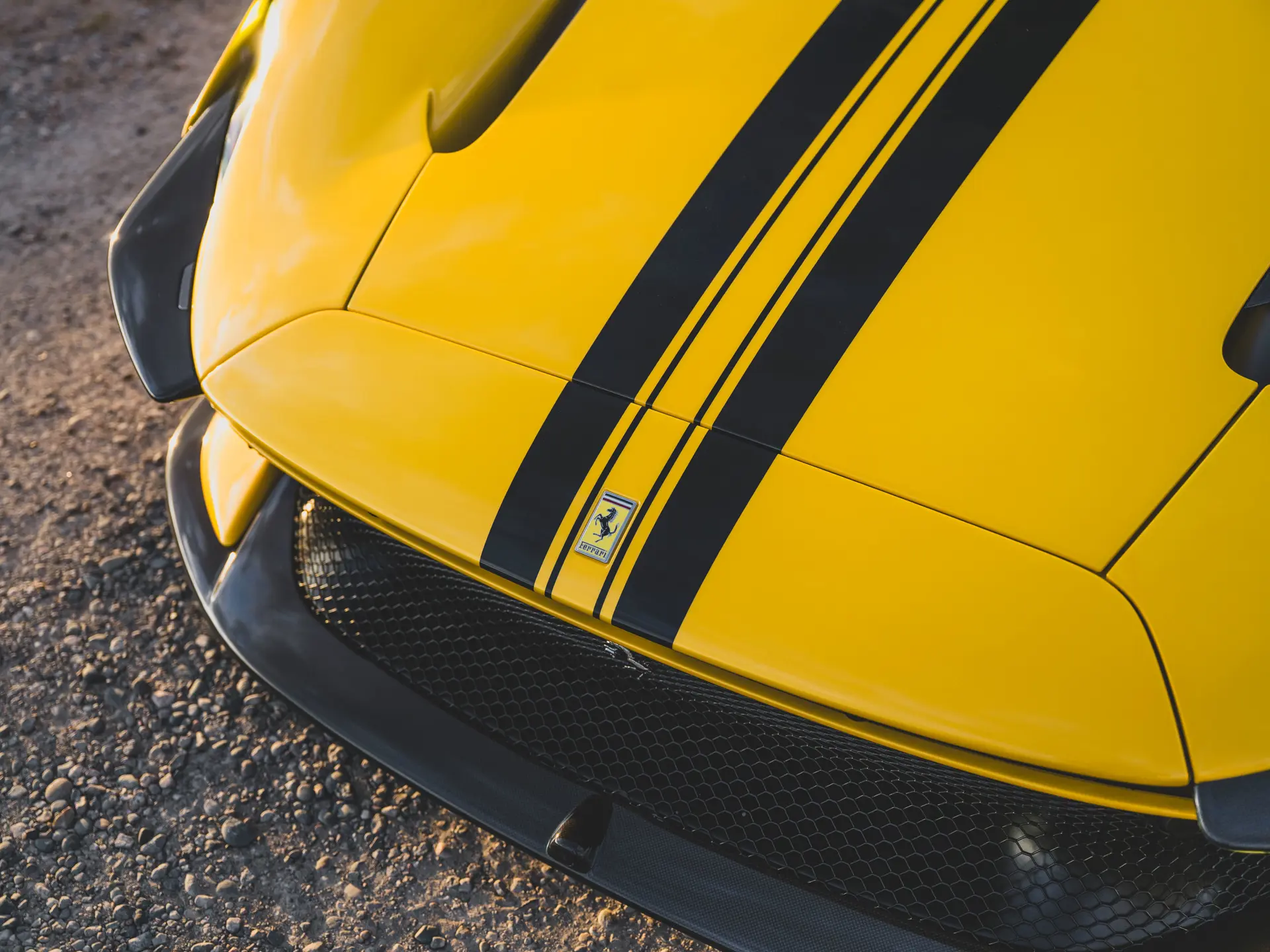
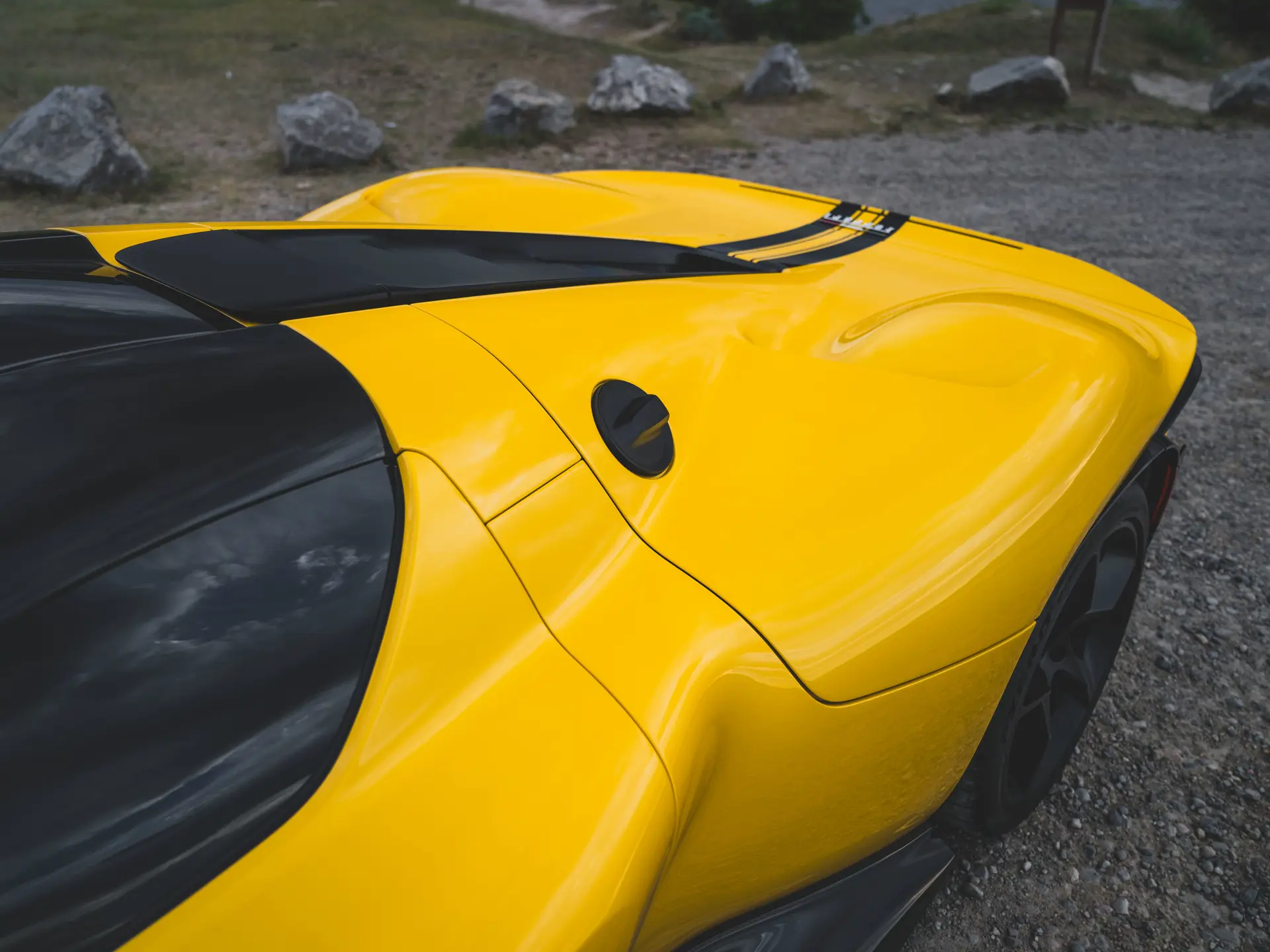
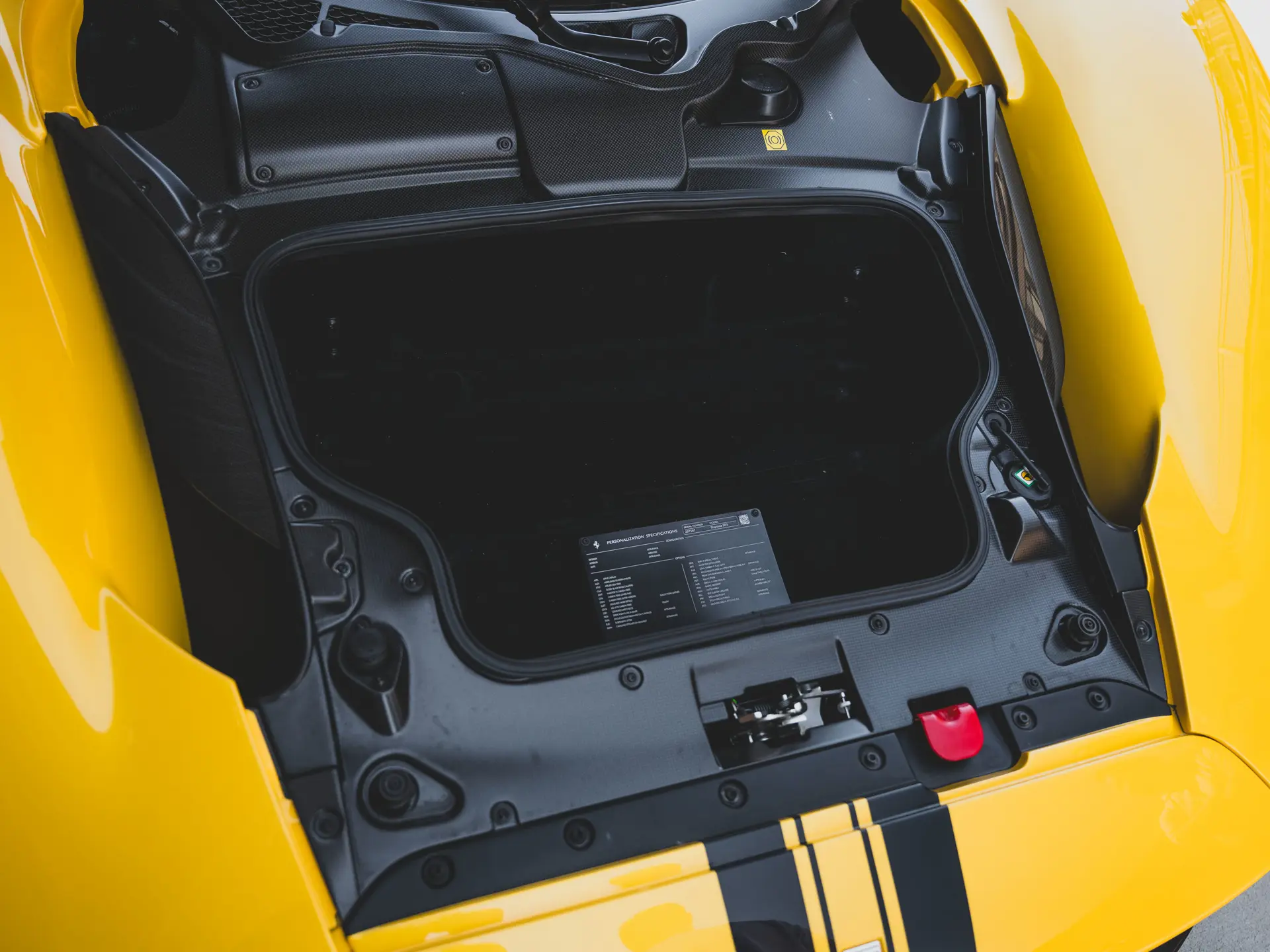
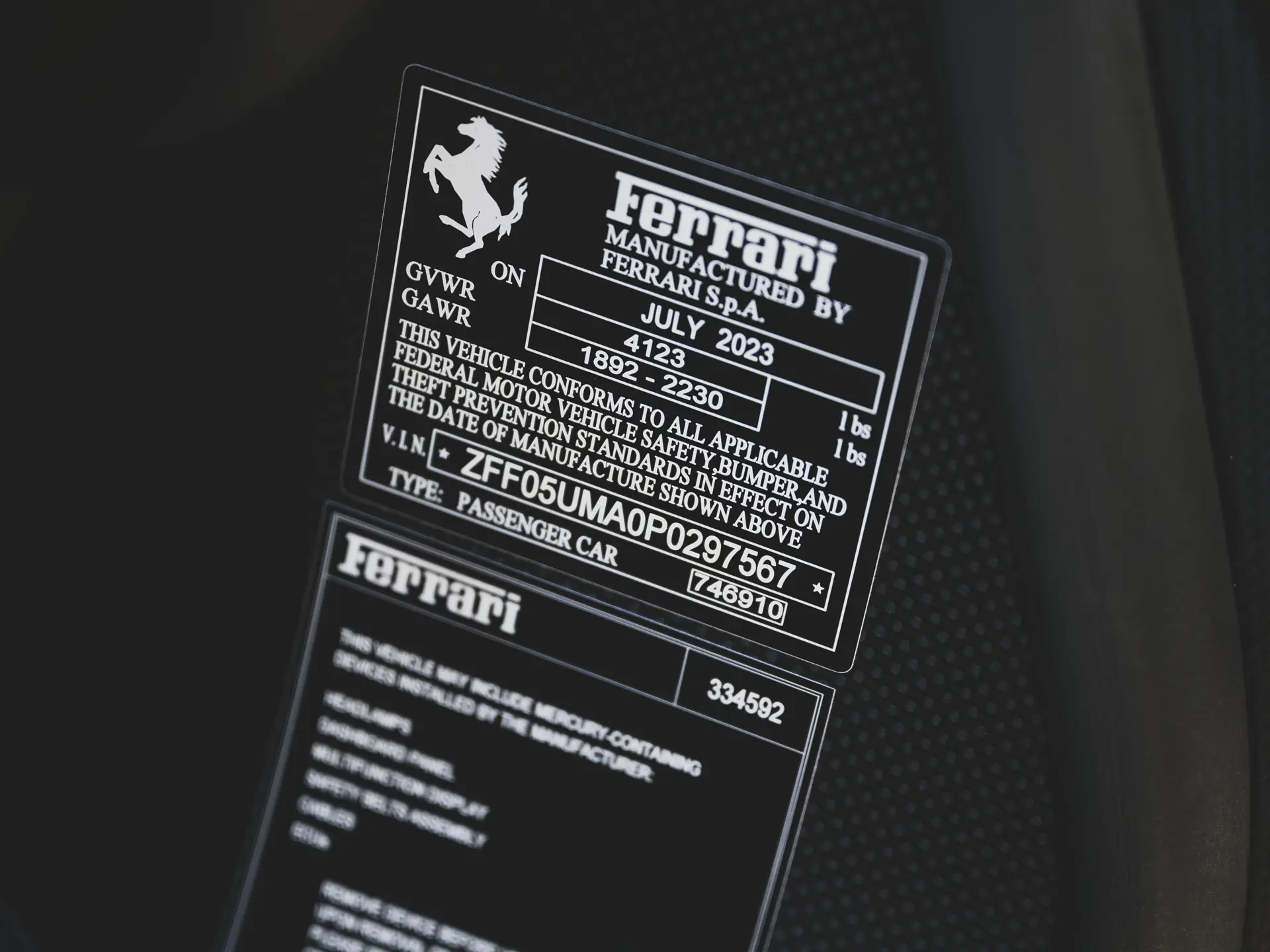
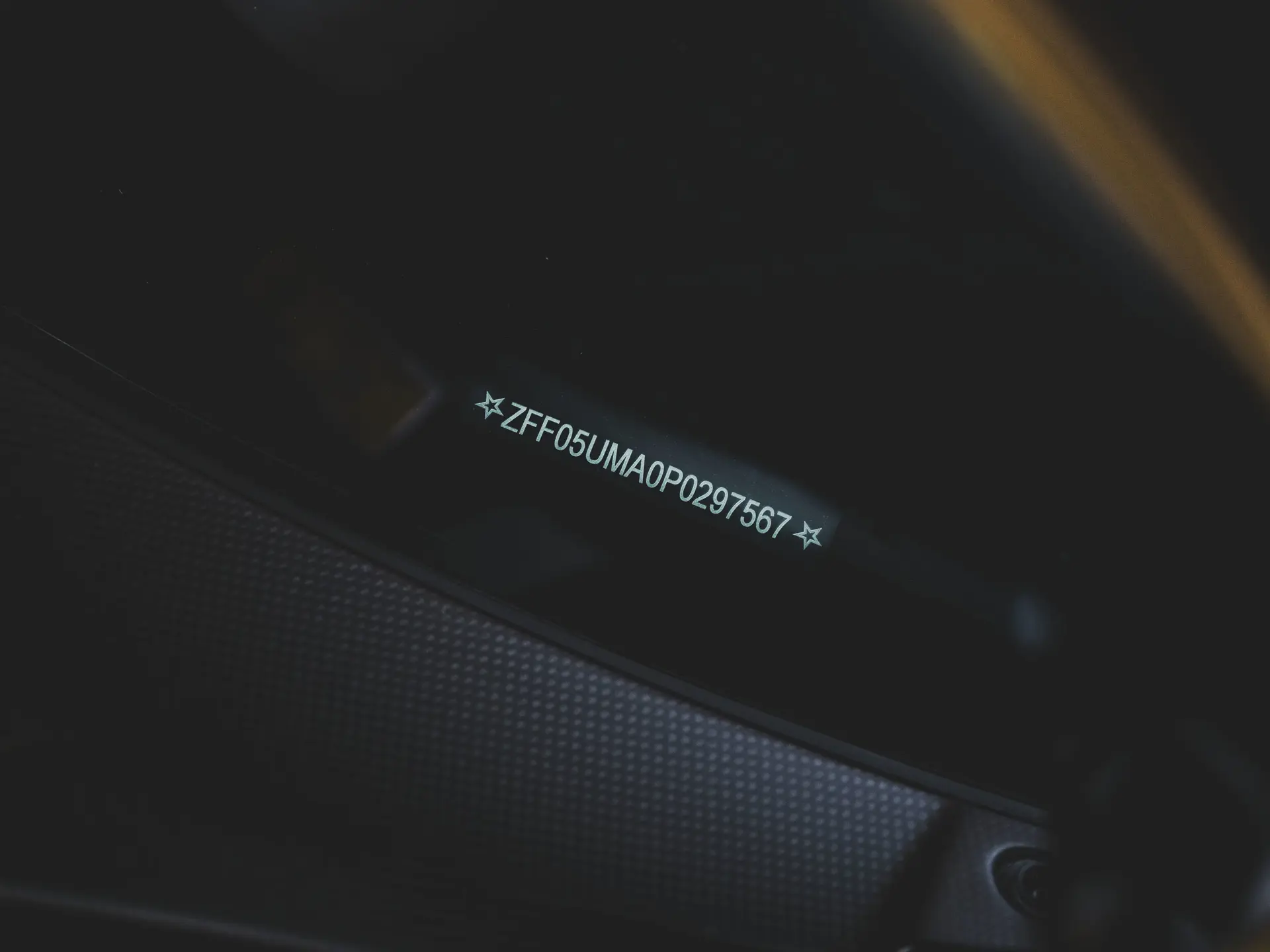
A Ferrari Daytona SP3 cost $2.25 million when Maranello opened the order book. RM Sotheby's has just estimated this one at $10,000,000 to $12,000,000, roughly five times list, and it will cross the block as lot 223 in Monterey on Friday 14 August 2026. The car is chassis 297567, finished in four-layer Giallo Triplo Strato with black racing stripes, built in July 2023 and driven 227 miles in the three years since. This is what that money is actually buying.
All 47 catalogue photographs of chassis 297567














The numbers behind the estimate
RM Sotheby's lists chassis 297567 at $10,000,000 to $12,000,000, with indicative equivalents of €9,000,000 to €10,500,000, £7,500,000 to £9,000,000 and CHF 8,000,000 to 9,500,000. It is offered from a private group described as The Driver's Philosophy Collection and is located in Monterey, California.
Against a $2.25 million list price, the low end of that estimate is a multiple of about 4.4 and the high end about 5.3. That gap is not a mystery: Ferrari sold the Daytona SP3 by invitation only, and the waiting list was effectively closed before the car was shown publicly. Every one of the 499 owners of the previous Icona models, the Monza SP1 and SP2, took an SP3 as well. Buyers who were not in that circle have had to go to the secondary market from the start.
There is also a reference point at the extreme end. In 2025 Ferrari built a 600th example, over and above the 599-car production run, and sold it during Monterey Car Week for $26 million with the proceeds going to the Ferrari Foundation. That car was a charity lot with a unique specification and should not be read as a market comparable, but it did put a very large number next to the model's name in public.
Why it is called the Daytona
The name points at one specific afternoon. Ferrari had won the 24 Hours of Le Mans outright six years in a row, from 1960 to 1965, before Ford's GT40 ended the run in 1966. Maranello's answer came at the start of the following season, at the 24 Hours of Daytona in February 1967, where the factory 330 P3/4 and 330 P4 finished ahead of the North American Racing Team's 412P for a side-by-side podium lockout.
The SP3 is the third car in Ferrari's Icona series, which pairs current drivetrains with bodywork that quotes the company's own history. The Monza SP1 and SP2 referenced the open-cockpit sports racers of the late 1940s and 1950s. The Daytona SP3 goes a decade later, to the mid-engined prototypes: the 330 P4 above all, with cues drawn from the 512 S, the 712 Can-Am, the 312 P and the 1968 250 P5 concept.
Design was led by the Ferrari Styling Centre under Flavio Manzoni. The car was unveiled on 20 November 2021 and shown in full two days later at the Finali Mondiali at Mugello.
The last unassisted V12 in the middle of a Ferrari
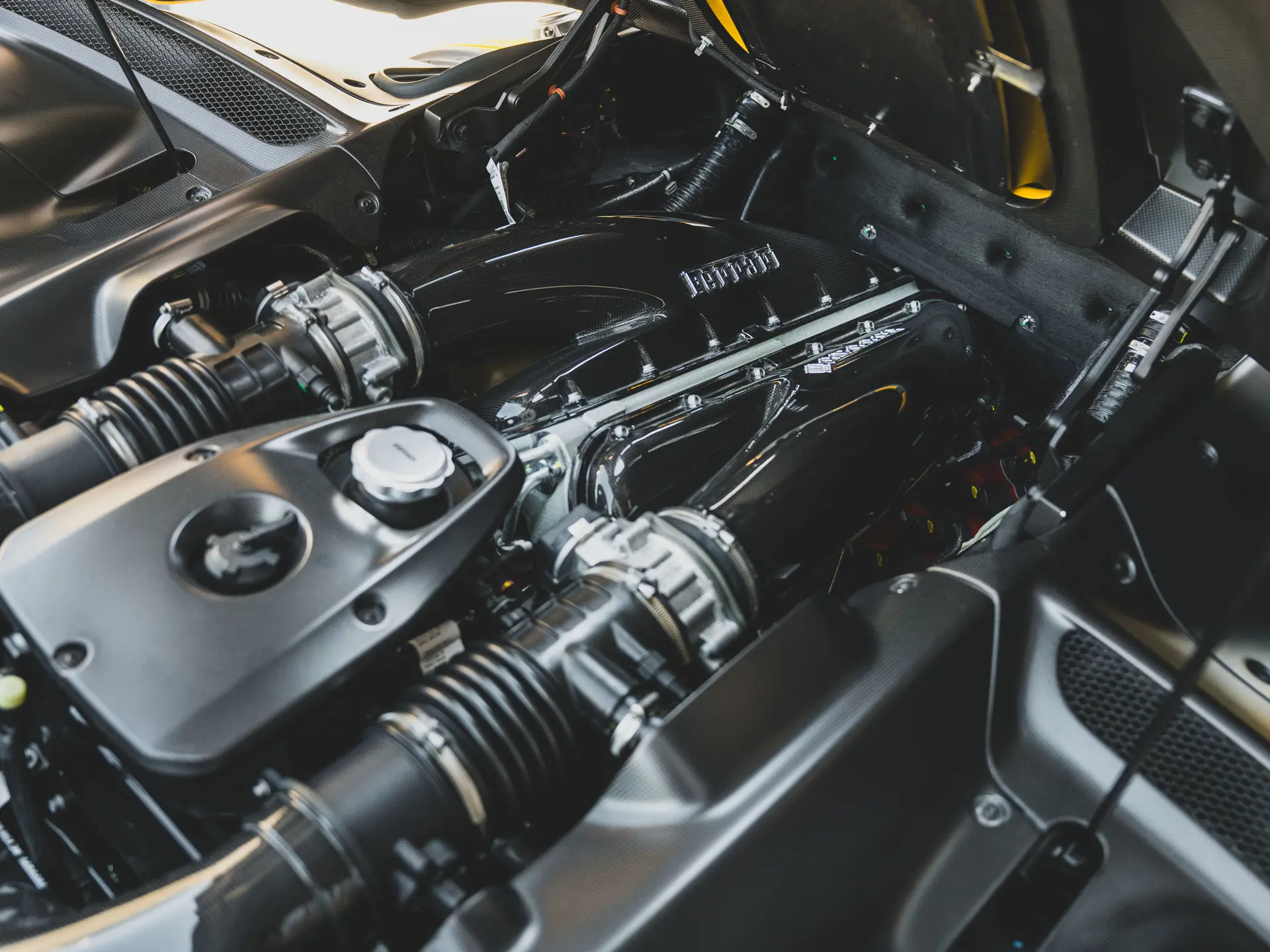
Under the slatted rear deck sits the F140 HC, a 6.5-litre naturally aspirated 65-degree V12 derived from the unit used in the 812 Superfast and, in hybrid form, the LaFerrari. Here the electric assistance is gone. Output is 840 PS (829 hp, 618 kW) at 9,250 rpm with 697 Nm at 7,250 rpm, and the limiter arrives at 9,500 rpm.
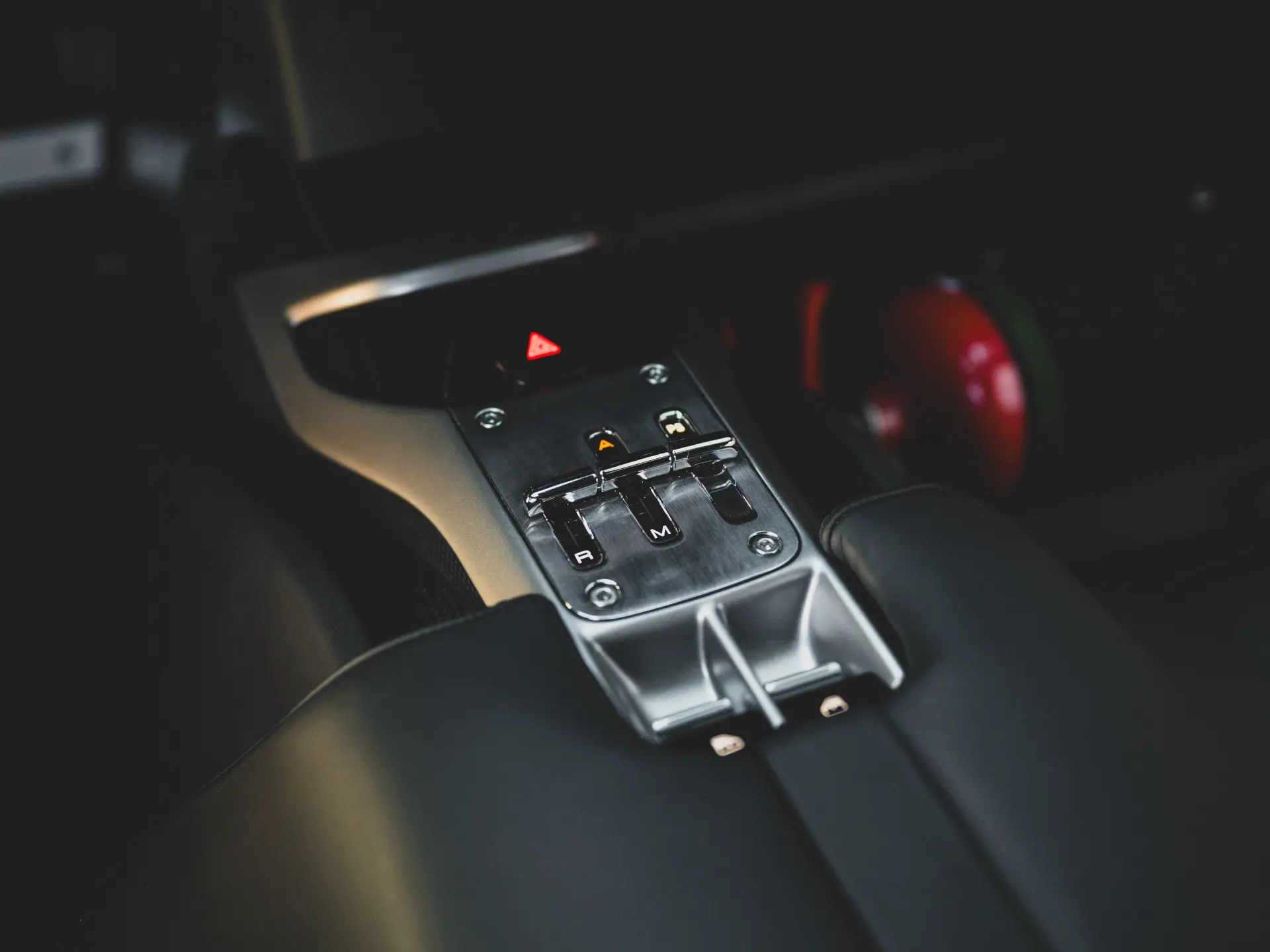
That makes the Daytona SP3 the first mid-mounted, non-hybrid V12 road Ferrari since the Enzo of 2002, a two-decade gap that is unlikely to be reopened. Drive goes to the rear wheels only through a seven-speed dual-clutch transmission that shifts in under 200 milliseconds, with an electronic differential, Side Slip Control 6.1 and the Ferrari Dynamic Enhancer.
Ferrari quotes 0 to 100 km/h in 2.85 seconds, 0 to 200 km/h in 7.4 seconds and a top speed above 340 km/h (211 mph). Dry weight is 1,485 kg with a 44/56 front-to-rear distribution, giving 566 PS per tonne. The structure is the LaFerrari Aperta carbon-fibre chassis, the bodywork is carbon, the doors are butterfly-hinged and the roof panel lifts out.
No active aerodynamics, on purpose
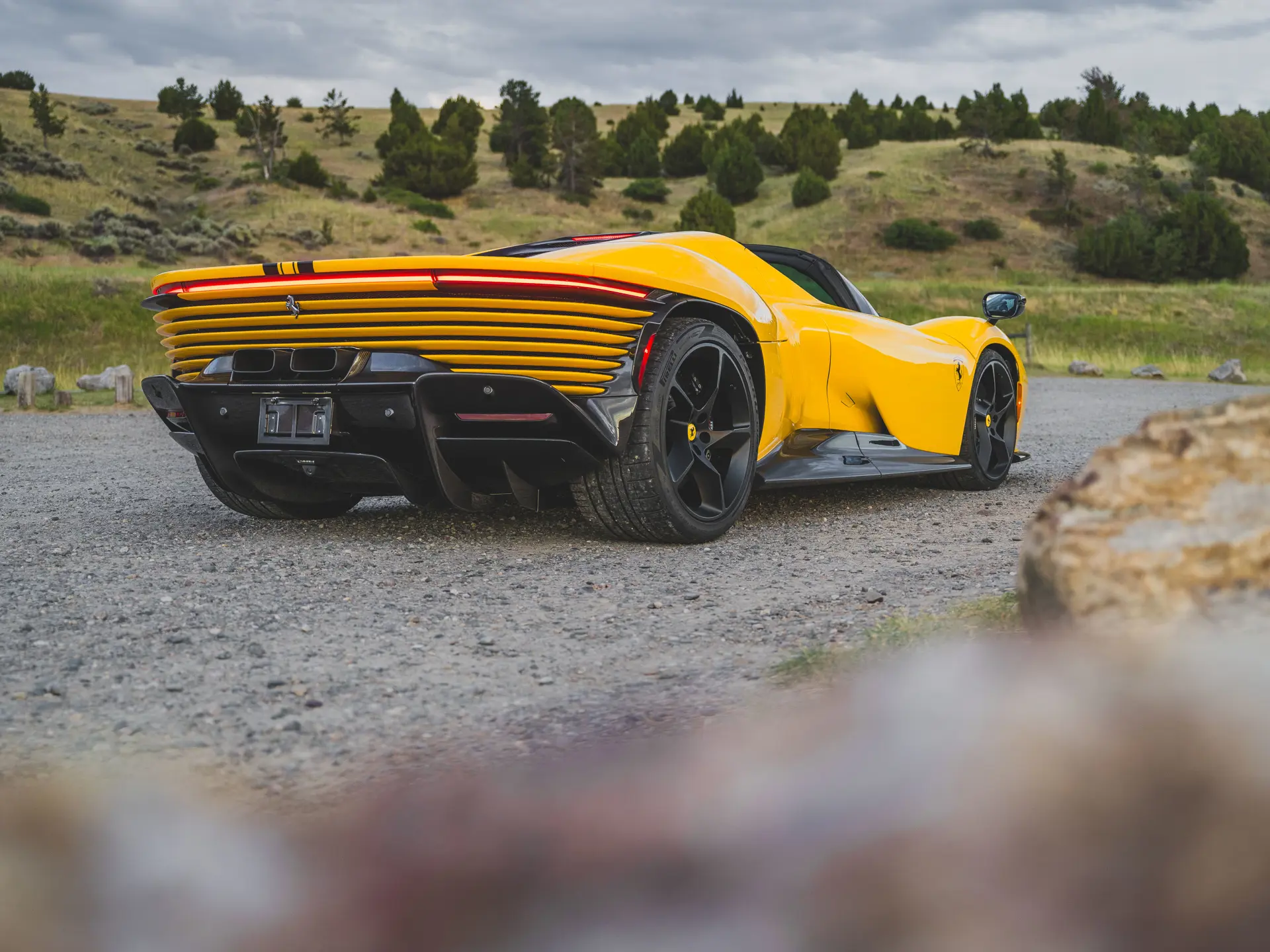
Almost every rival in this class uses moving aerodynamic surfaces. The Daytona SP3 does not. Ferrari committed to a fully passive package and spent the development effort on shaping the airflow instead: chimneys that pull low-pressure air out from under the floor, radiator ducts routed inside the door trim, and a rear diffuser doing the heavy lifting.
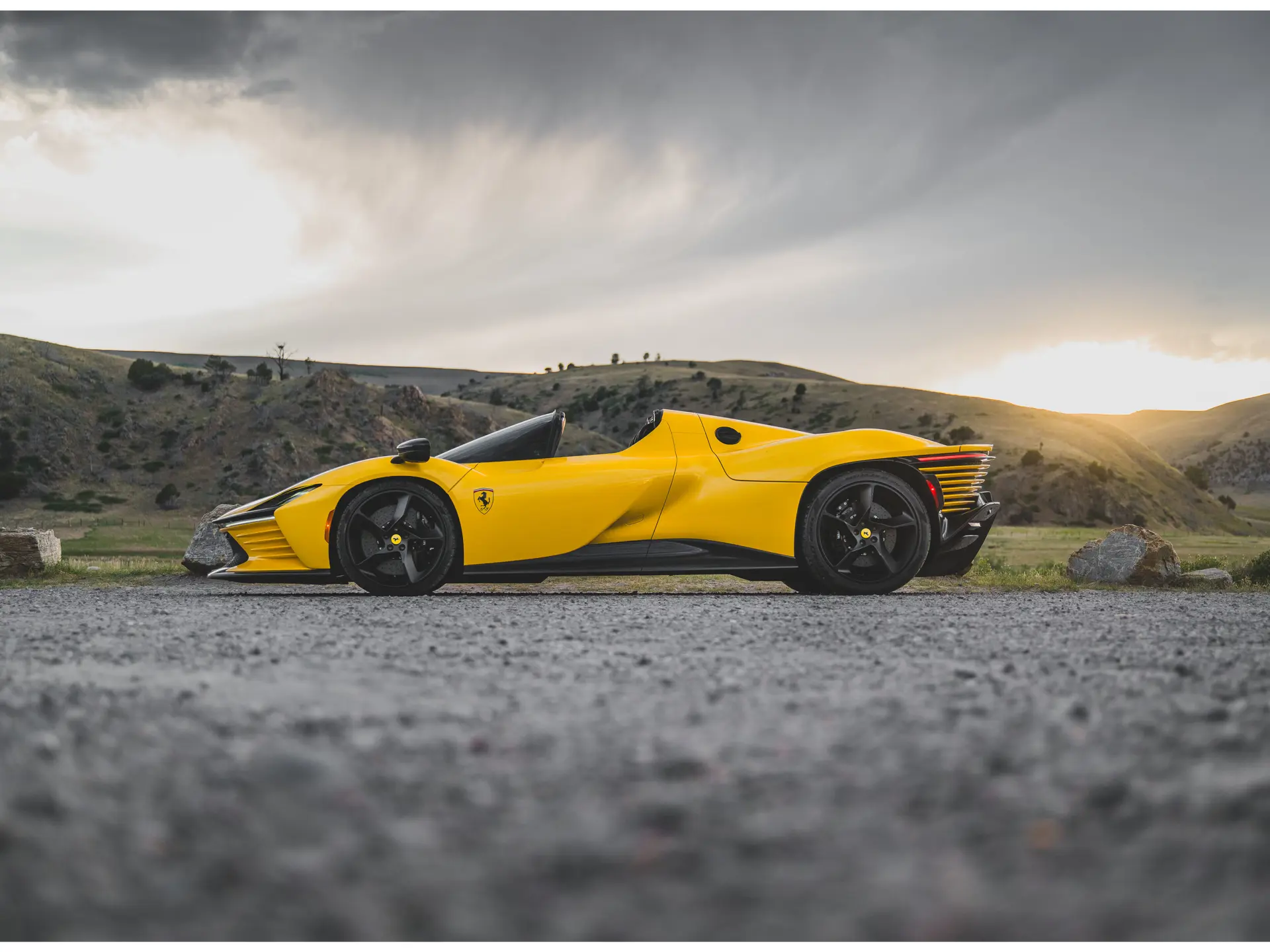
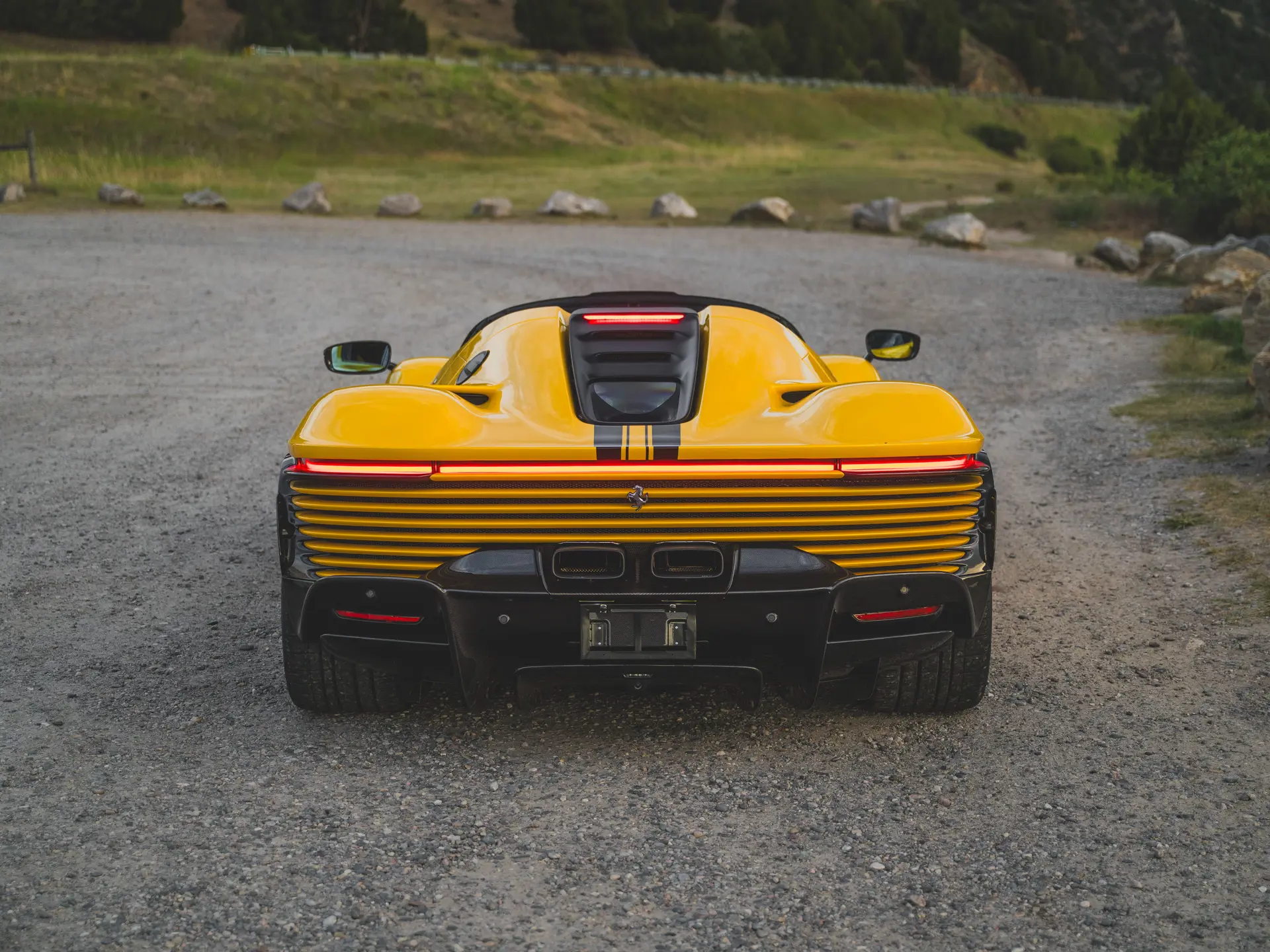
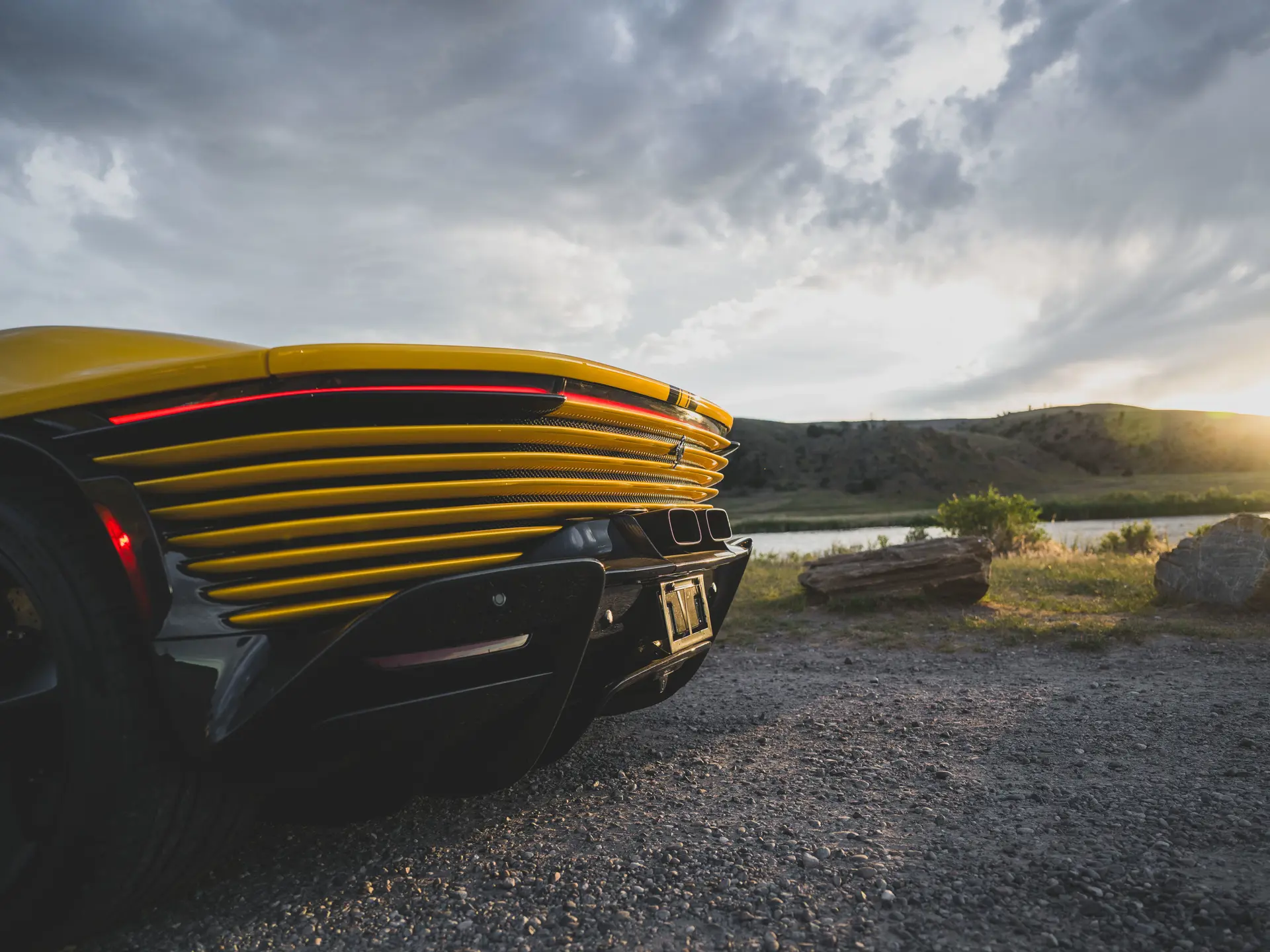
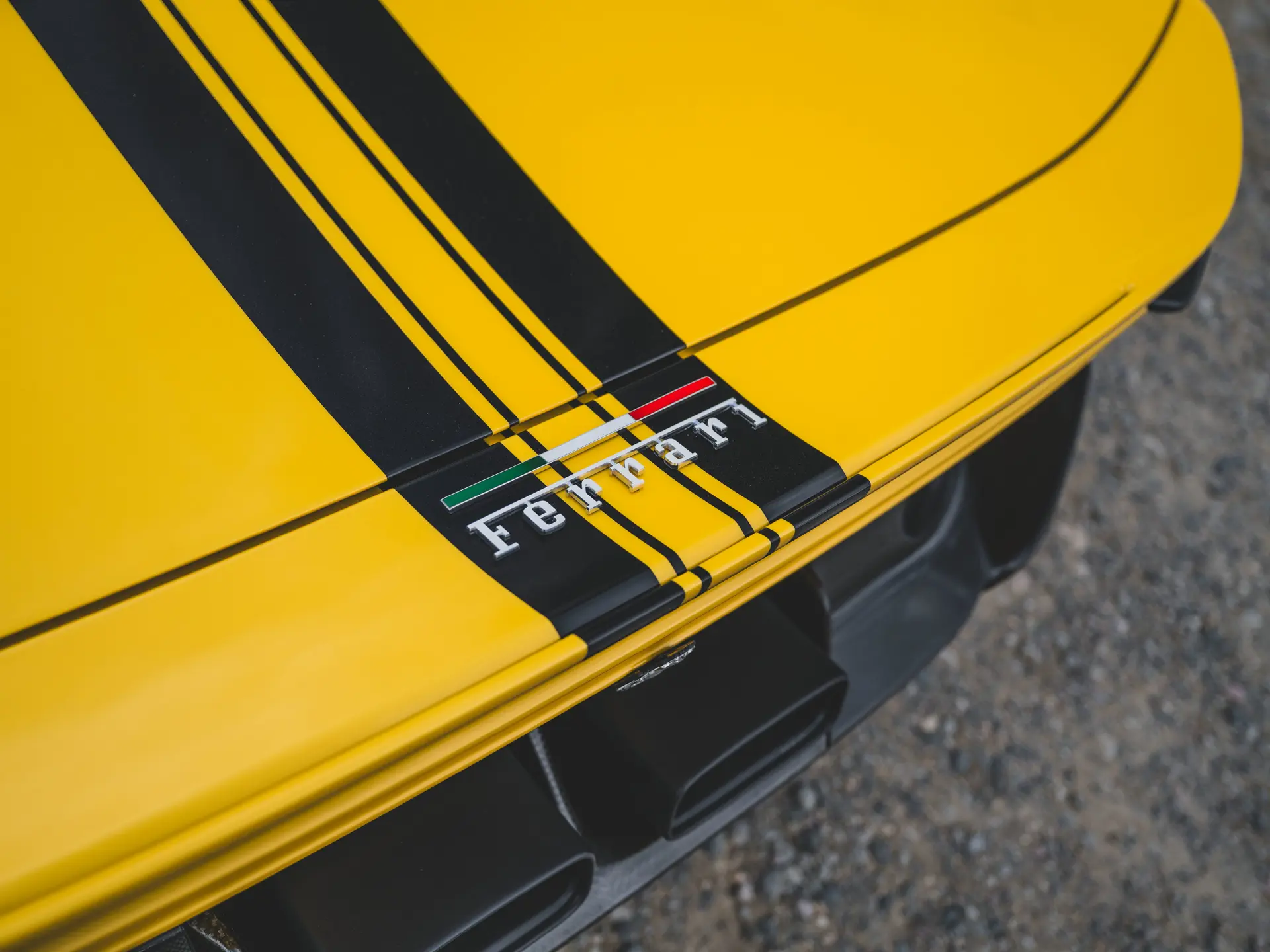
The result is roughly 230 kg of downforce at 201 km/h and, at launch, the most aerodynamically efficient passively-cooled Ferrari the company had built. It is also the reason the car looks the way it does. There is no wing to interrupt the rear volume, so the horizontal slats can run the full width of the tail exactly as they do on a 1960s prototype.
The rest of the surfacing follows the same logic: a low wraparound windscreen, pronounced double-crested front wings, fender-mounted mirrors and deep flanks that feed the intakes. It is a shape that reads as a design exercise but was mostly settled by airflow.
Chassis 297567: a bespoke Atelier commission
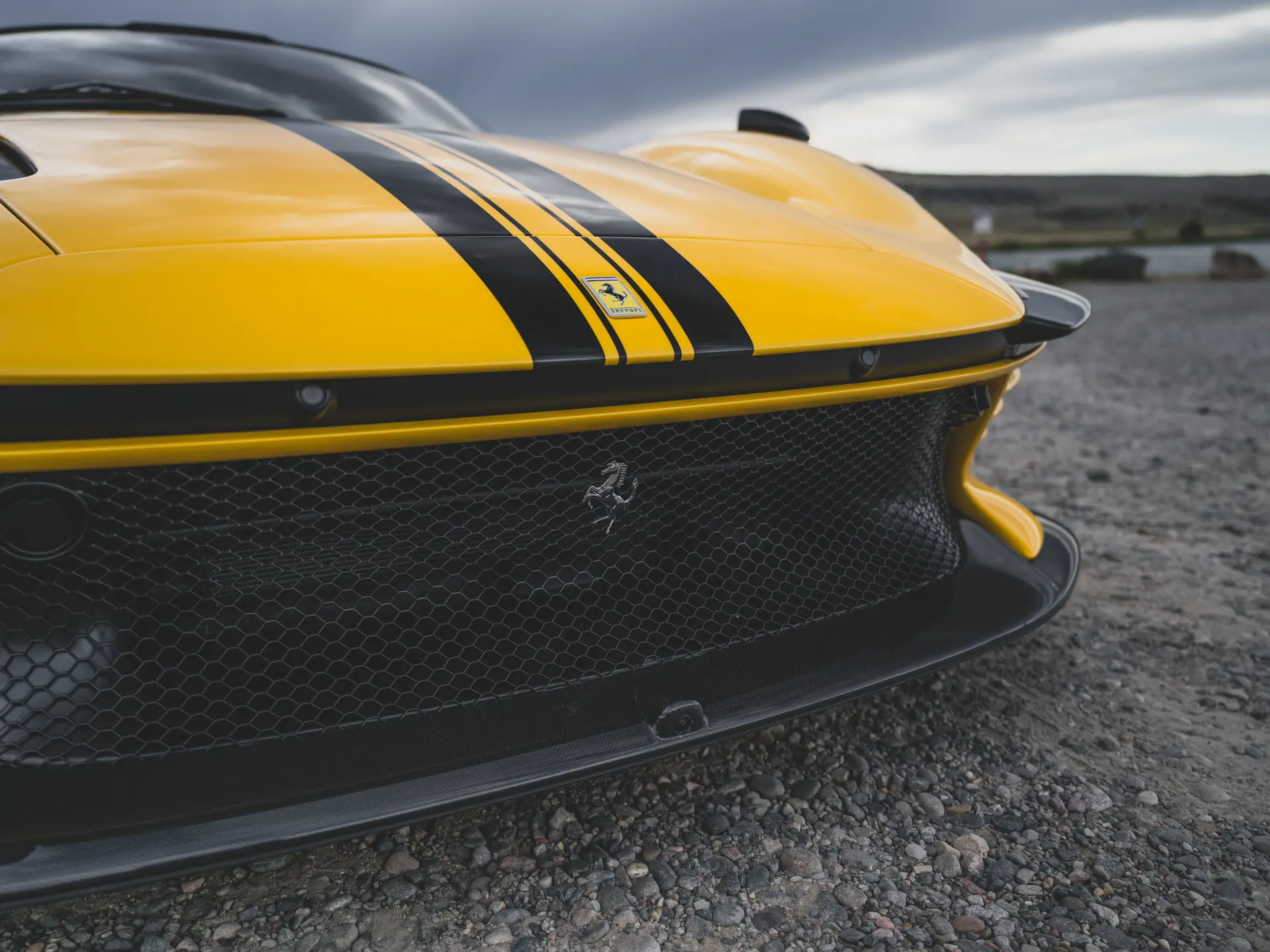
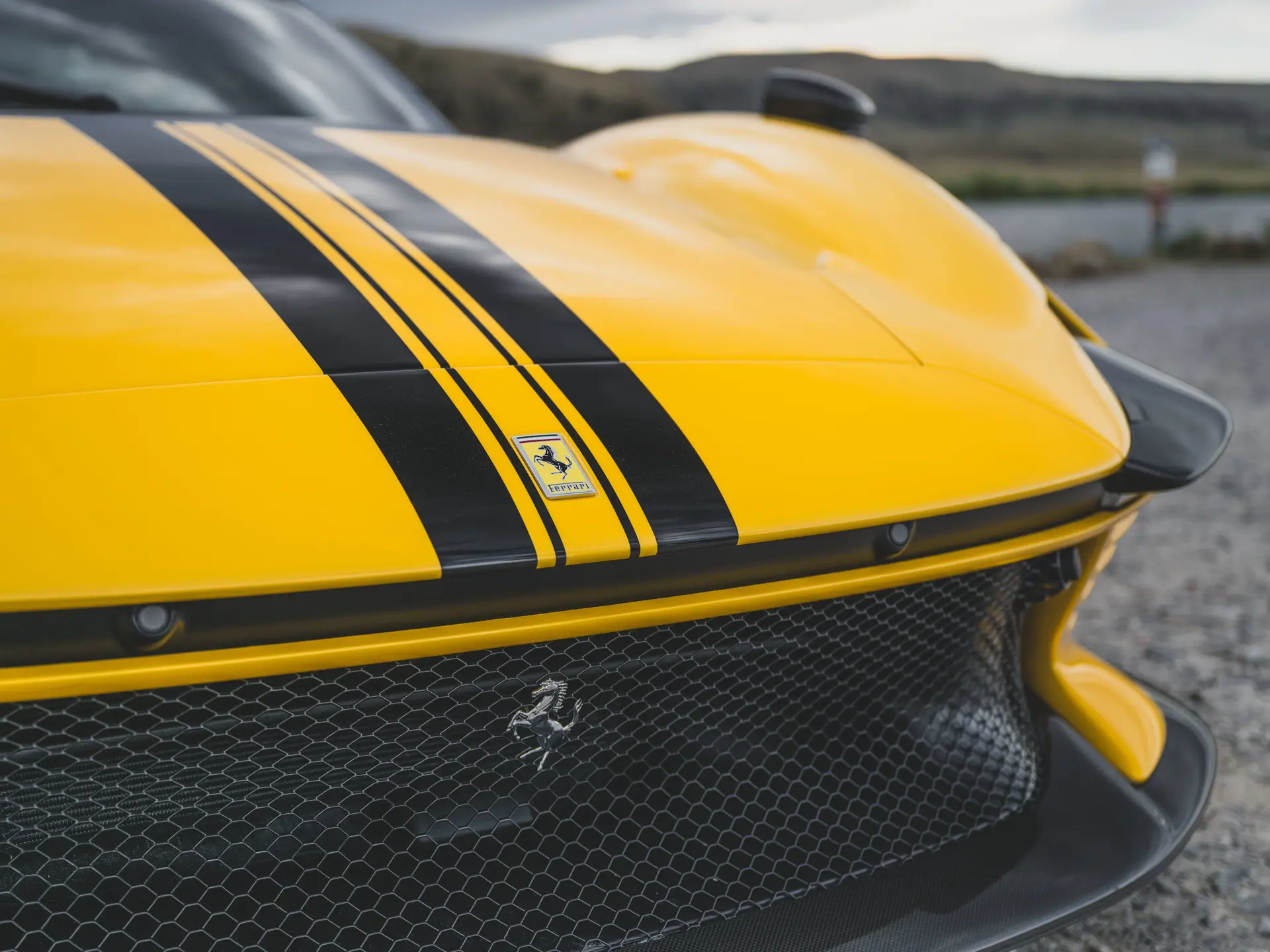
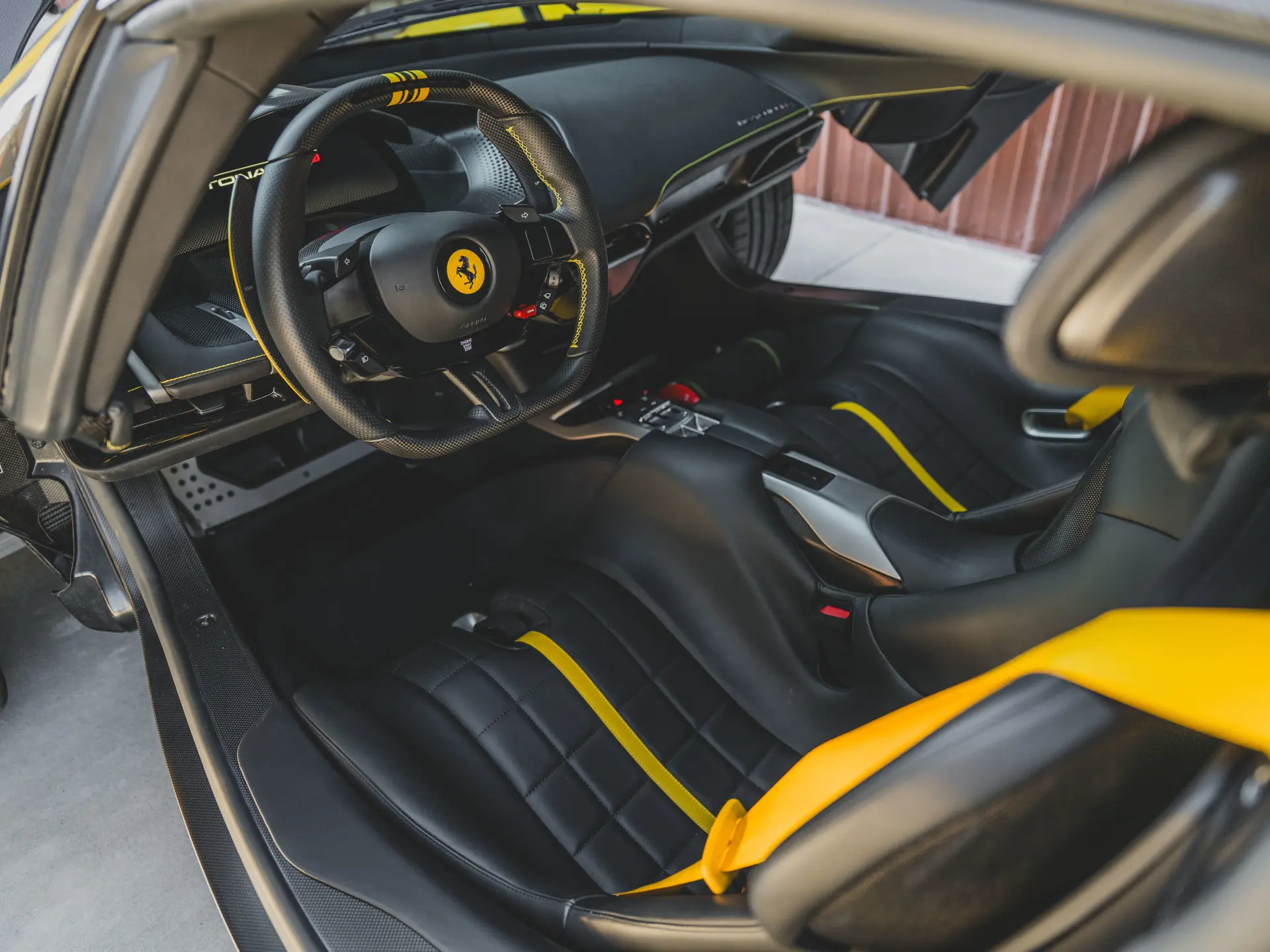
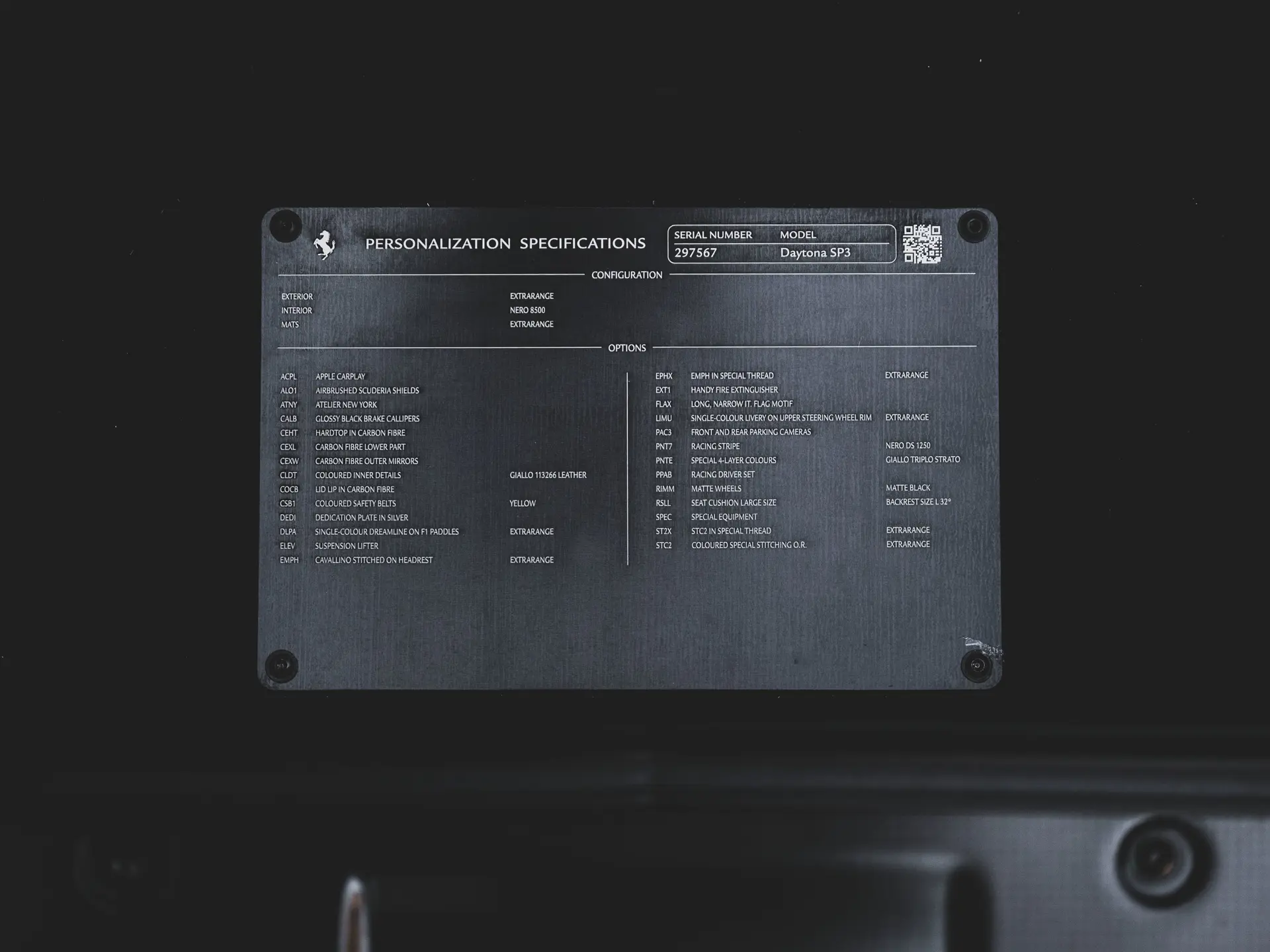
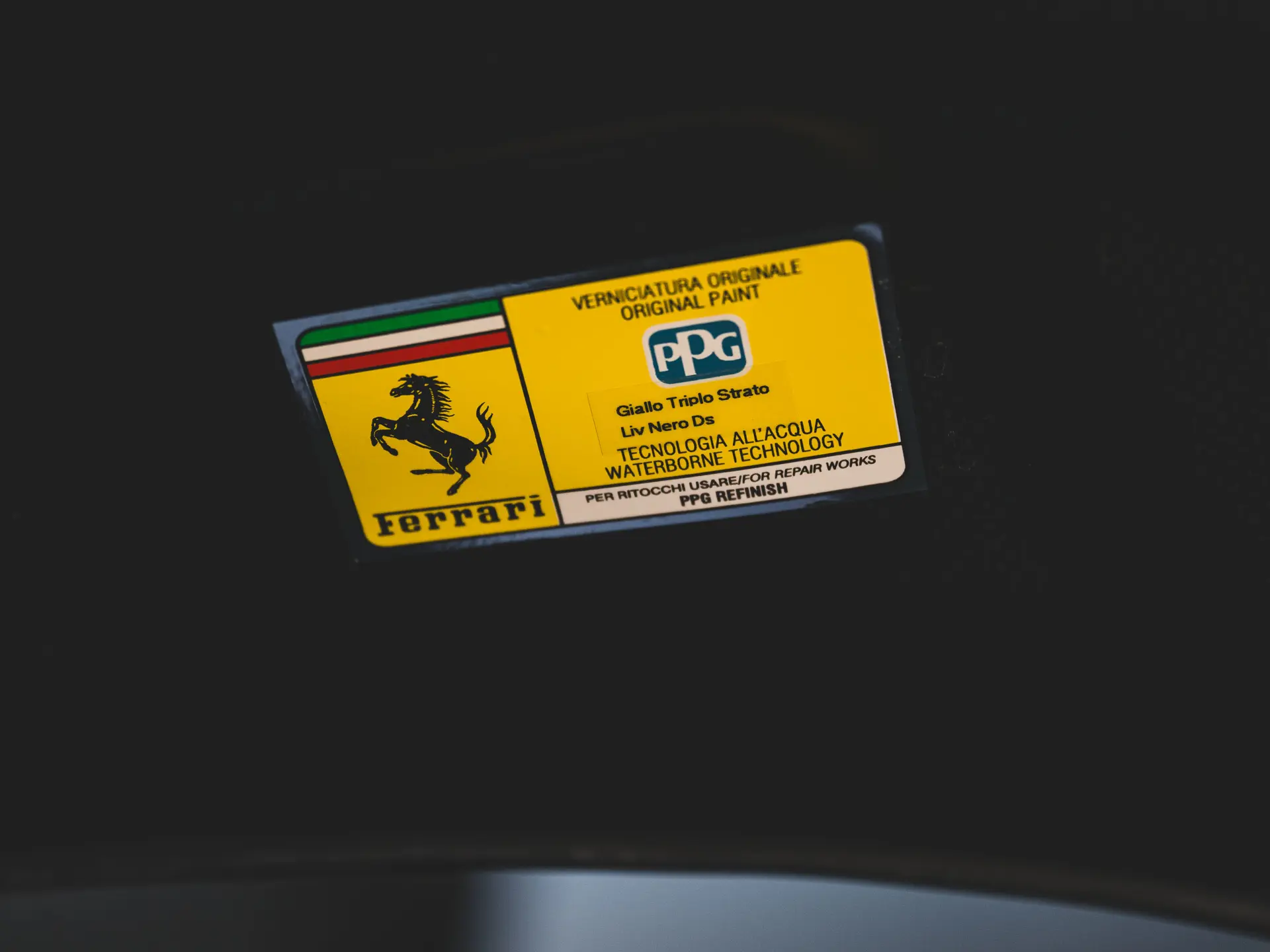
This car was configured through Ferrari's Atelier programme in New York and completed assembly in July 2023. The exterior is Giallo Triplo Strato, a four-layer special colour, cut by Nero DS 1250 racing stripes and a long, narrow Italian flag motif. The cabin is Nero 8500 with Giallo accents.
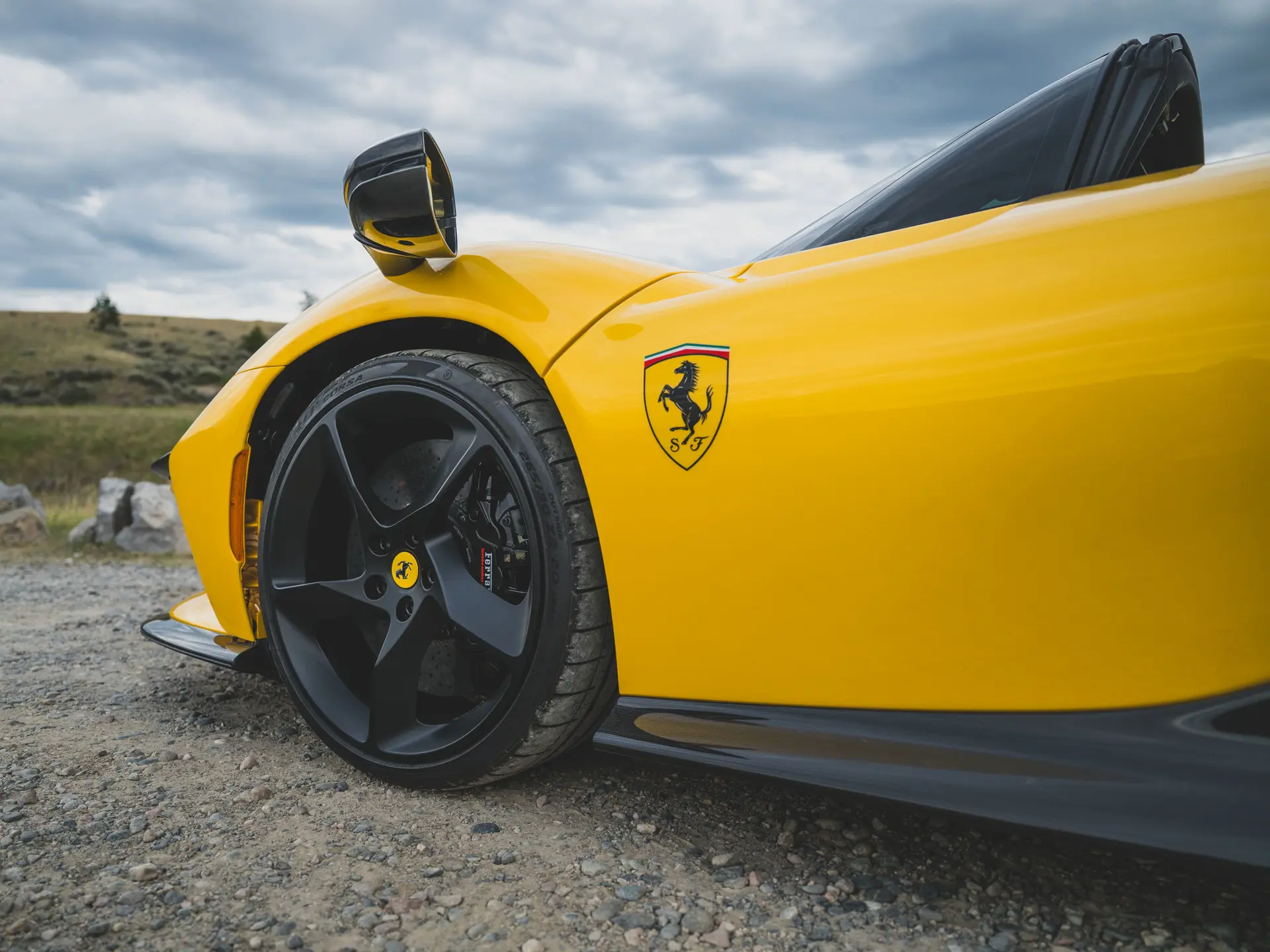
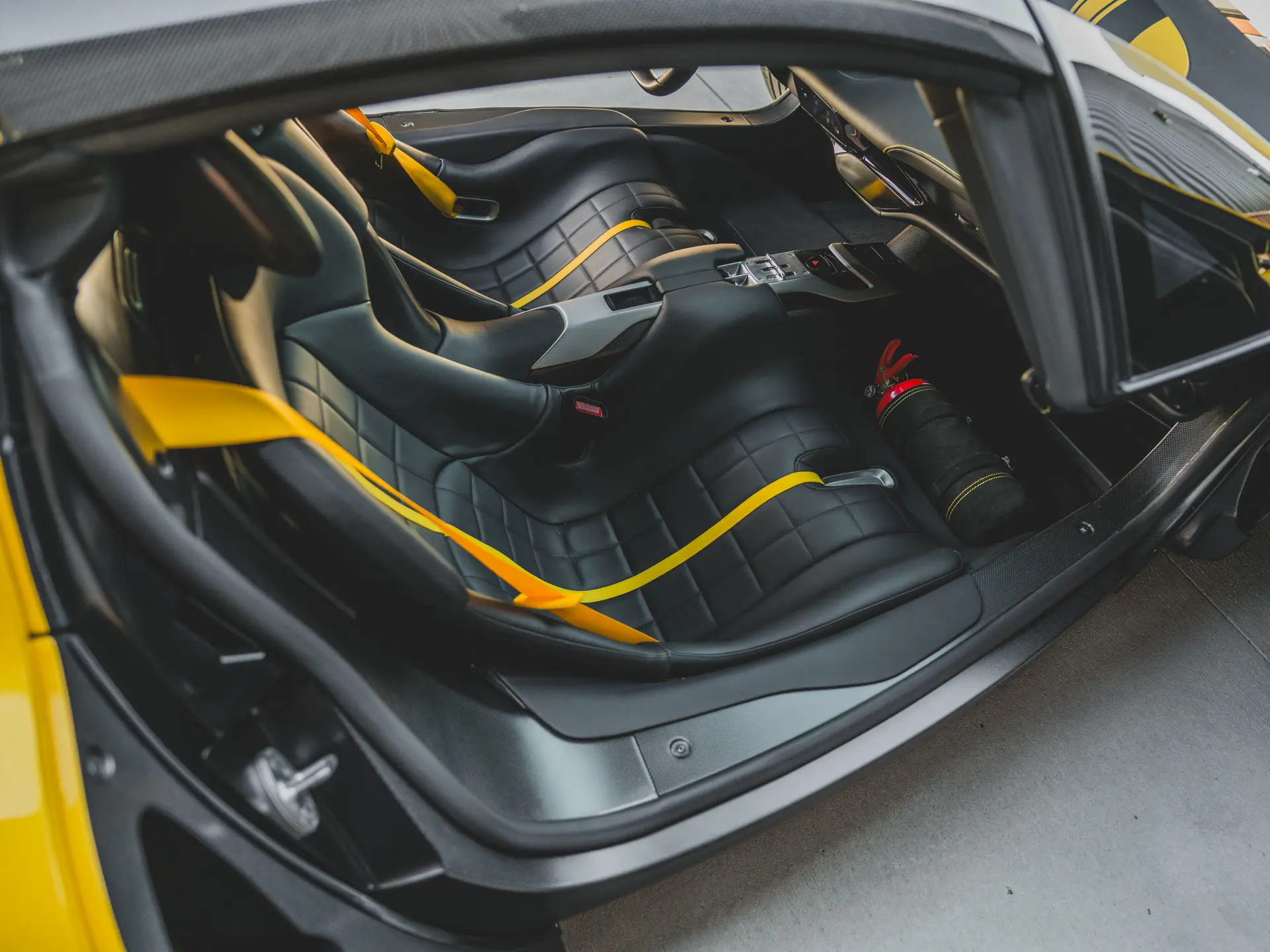
The option list on the car's personalisation plate is long: carbon-fibre hardtop, carbon-fibre lower bodywork and carbon outer mirrors, matte black wheels with glossy black brake callipers, airbrushed Scuderia shields, suspension lifter, and a silver dedication plate. Inside there are Giallo leather inner details, yellow safety belts, Cavallino Rampante stitched into the headrests, single-colour Dreamline on the F1 paddles, a single-colour livery on the upper steering wheel rim, Apple CarPlay, front and rear parking cameras, a racing driver set and large seat cushions.
That last item is not a vanity option. The Daytona SP3's seats are moulded into the carbon structure and do not move; the pedal box adjusts instead. Cushion and backrest sizing is how the car is fitted to its owner, which is one reason a second-hand SP3 is not automatically a comfortable car for the next buyer.
227 miles, two owners, and what that actually means
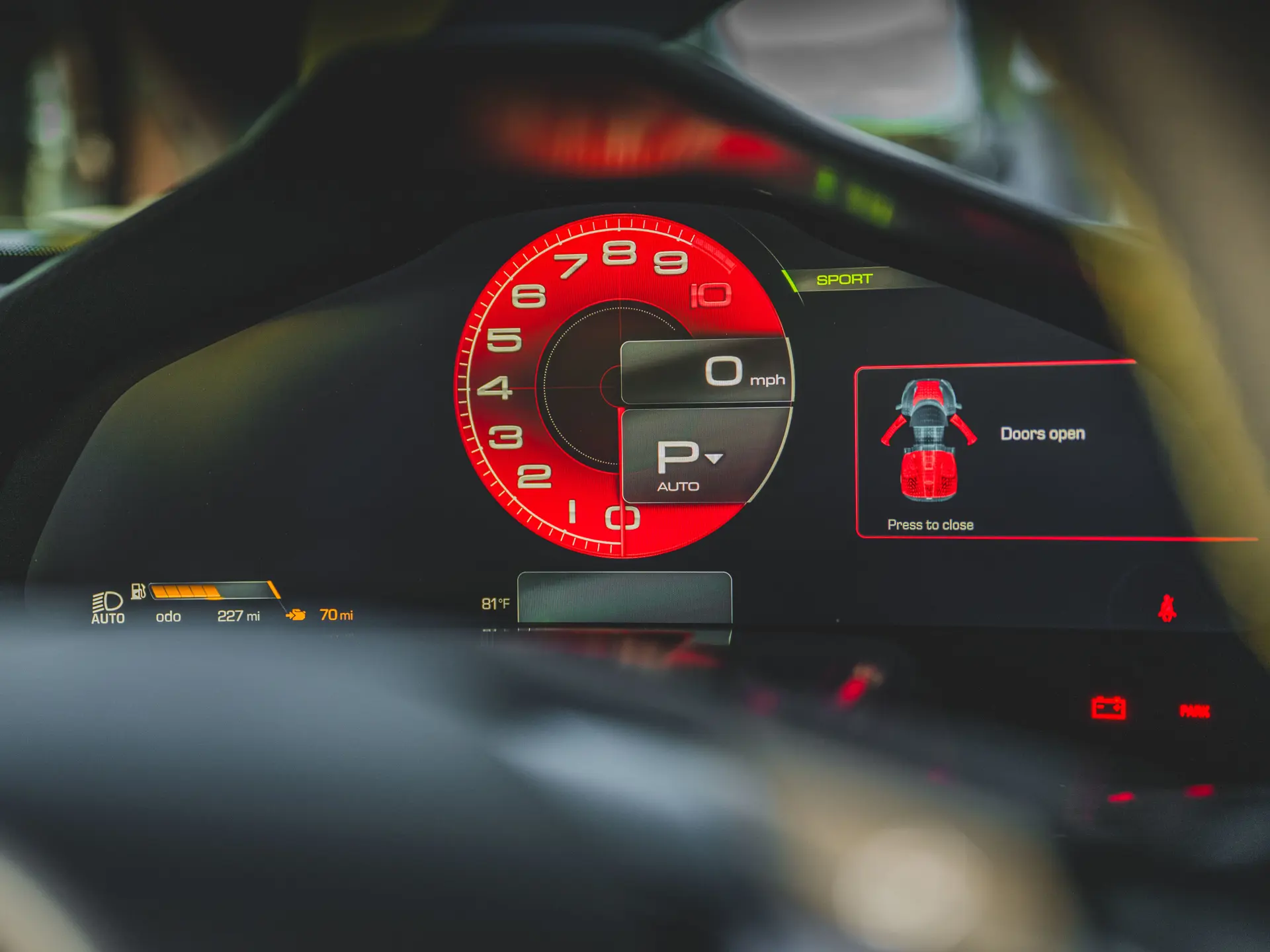
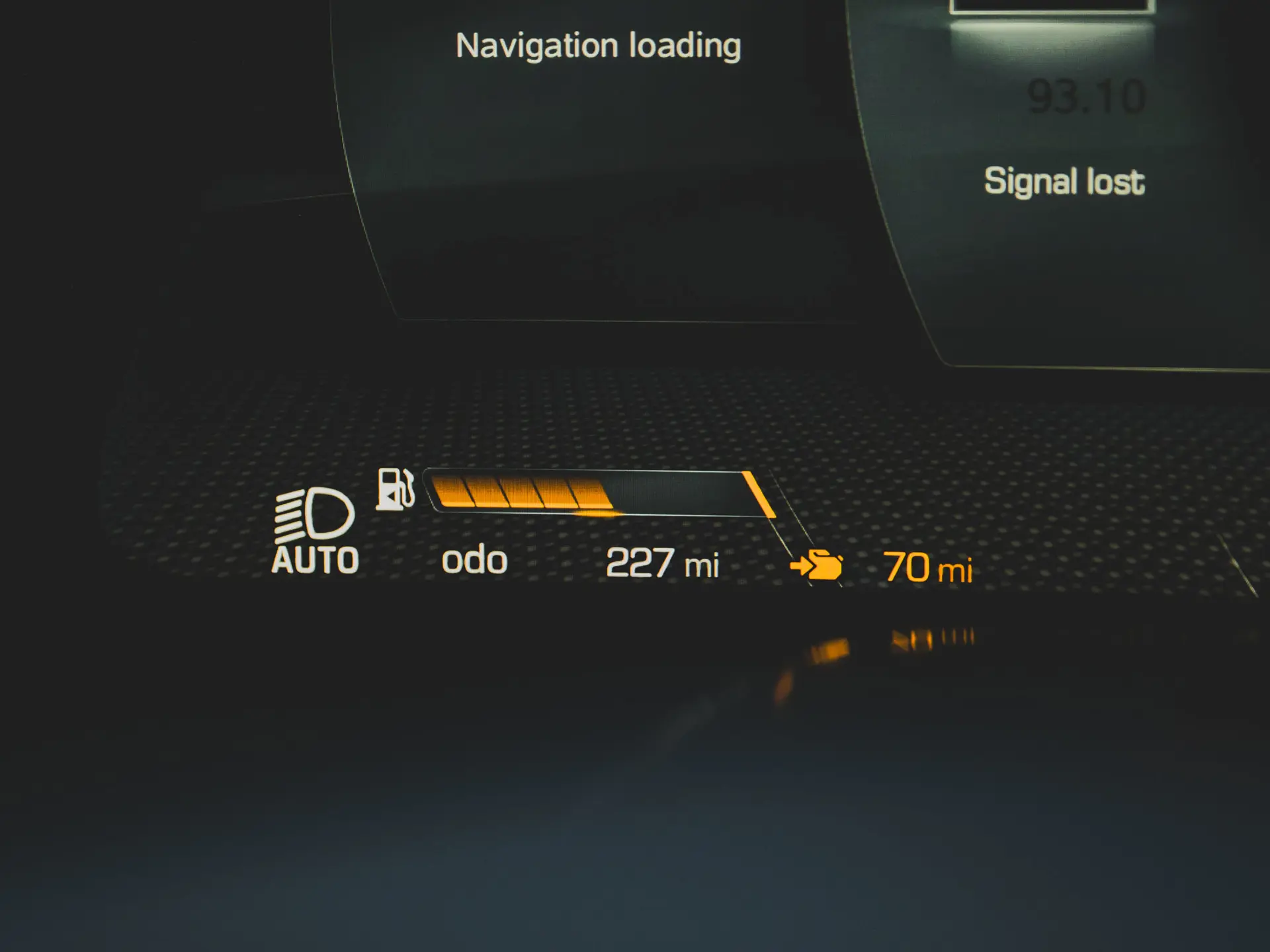
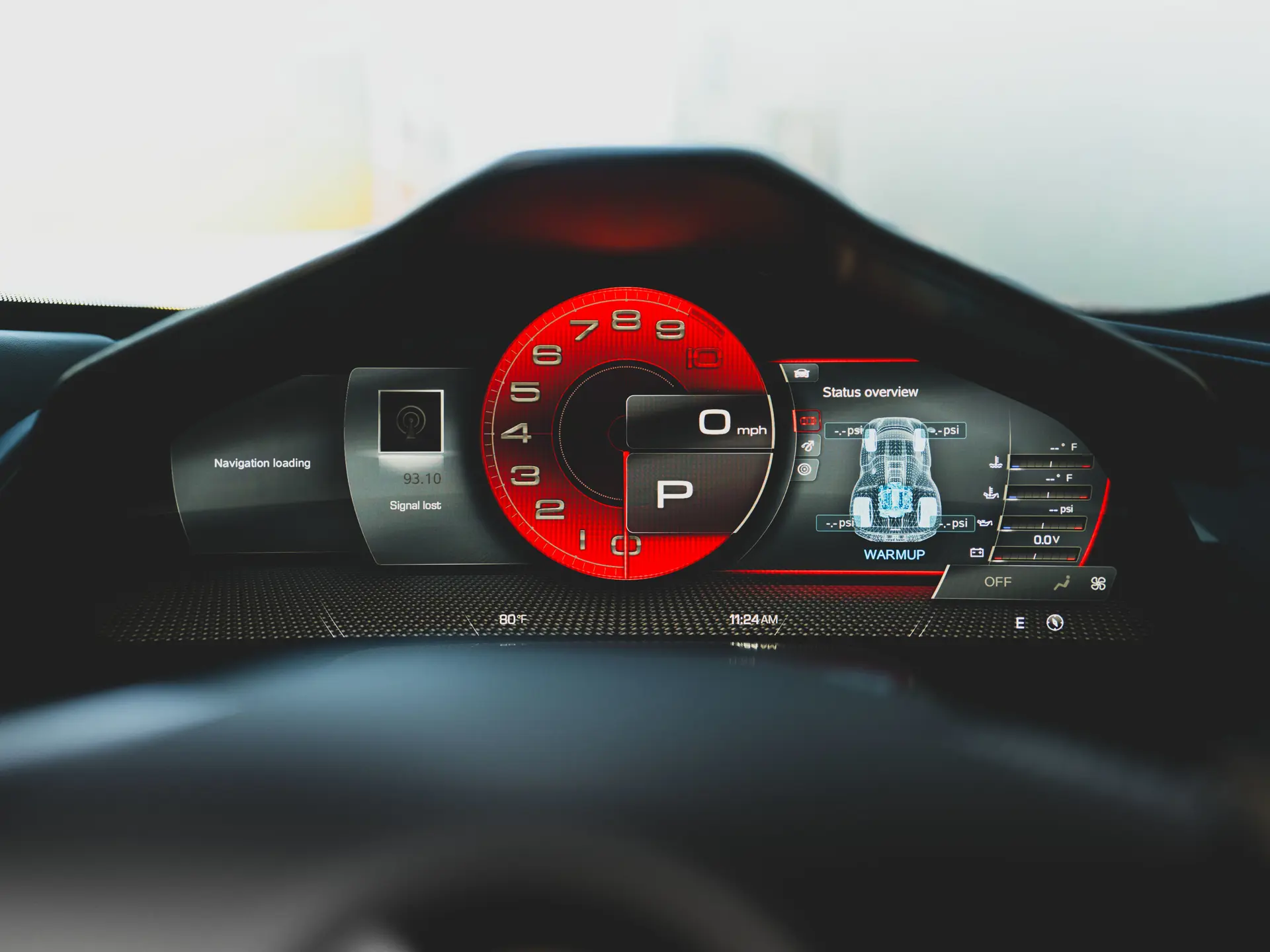
The car was retailed through Wide World of Cars in Spring Valley, New York, and delivered in January 2024 to a Florida-based enthusiast. It returned to the same dealership twice for servicing before being sold to the present collection in October 2025, when the odometer showed roughly 220 miles. At the time of cataloguing it read 227 miles, and the figure is visible in the instrument cluster photographs.
Two owners inside three years and a delivery-mileage odometer is exactly the profile that maximises price in this segment, and RM Sotheby's presents it as such. The car comes with its original owner's manuals in the correct pouch, the accessory tool kit, the fitted cover and the battery conditioner.
It is worth being clear-eyed about the trade-off. A car that has covered 227 miles in three years has not been used in any meaningful sense, and modern hypercars do not always benefit from long static storage: seals, fluids and batteries all prefer being exercised. The service record here is short because the mileage is short, not because the car has been ignored, but a buyer should still expect a full recommissioning inspection rather than assuming a delivery-mileage car is a fresh one.
What a $12 million result would say about the Icona market
The Icona series was designed to be scarce in a very deliberate way: limited runs, invitation-only allocation, and a client base that already owns the previous chapters. That structure creates a secondary market where supply is almost entirely a function of how many owners decide to sell in a given year, and where a striking specification can matter as much as chassis number.
This one is unusually loud for the model. Most SP3s were ordered in reds, silvers and darker metallics; a four-layer yellow with black stripes and an Italian flag is a specification that announces itself. Whether that helps or hurts depends on the bidder. Bold colours tend to widen the gap between the people who love a car and the people who will pay for it.
The counter-argument is straightforward: at $10 to 12 million the SP3 is being priced against genuinely historic machinery, including cars with race records and single-digit production numbers. A 599-car series built three years ago is a different proposition, however good it is. The result on 14 August will tell us which of those two readings the market currently holds.