








 Deutsch
  Français
  Italiano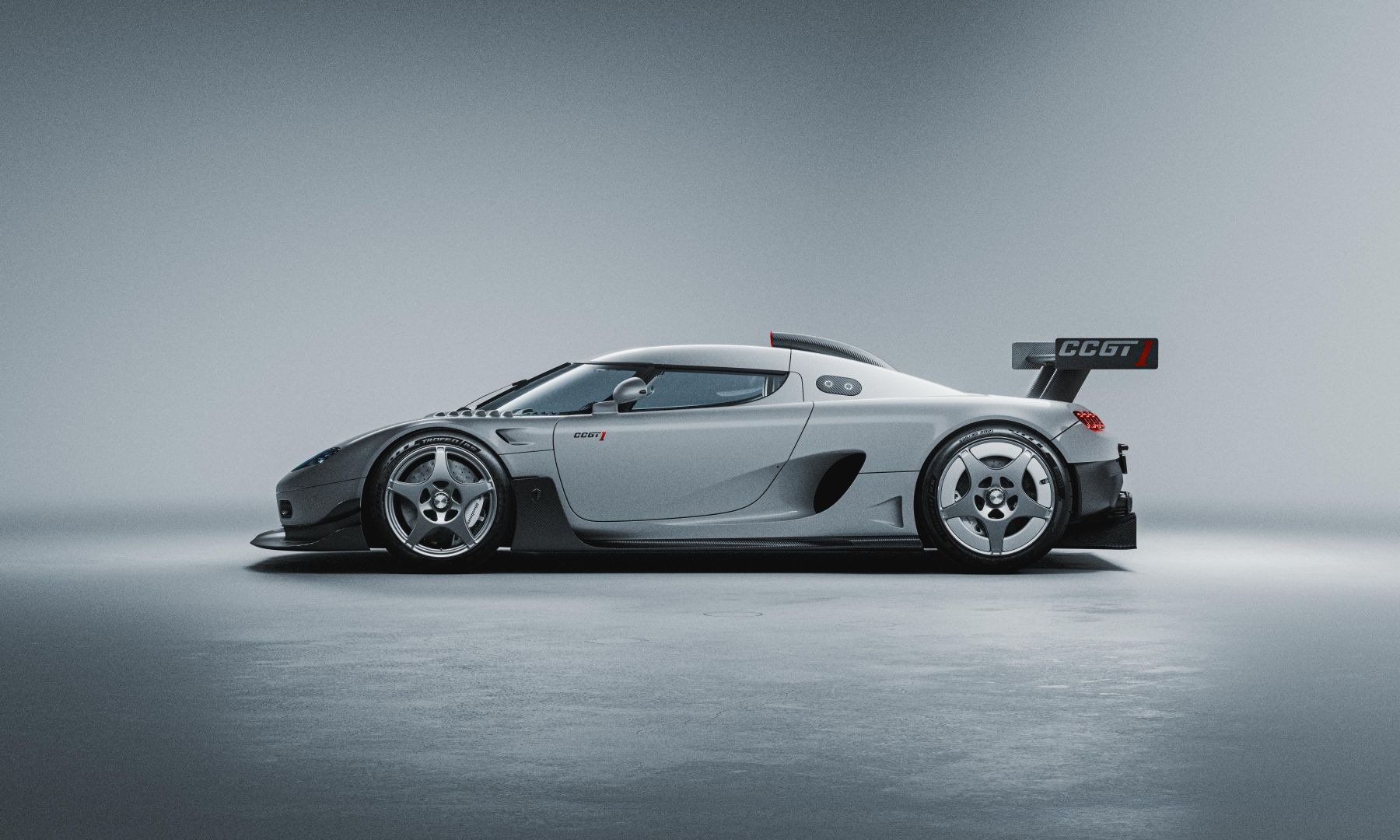
Koenigsegg has revealed the CCGT1, an edition of 70 road-legal cars built as a tribute to the CCGT, the GT1 racing car it built exactly once in 2007 and never raced. The new car makes 1,280 hp on pump fuel and 1,600 hp on E85, and Koenigsegg says it will be the fastest car it has ever built on a circuit.
The Koenigsegg CCGT1 in detail





What Koenigsegg has confirmed
The CCGT1 is a new car, not a restoration and not a continuation. Koenigsegg presents it as the modern tribute to the CCGT, the same relationship the CC850 has with the CC8S, and states that it is fully homologated and road legal in standard form all over the world. It is built as an exclusive edition of 70 vehicles.
Koenigsegg also makes a performance claim in its own words: the CCGT1 will have the highest performance on track of any Koenigsegg so far. That is a comparative statement against the Jesko Attack and the Sadair's Spear rather than a lap time, and no circuit figure has been published to support it yet.
The platform underneath is the CC850, the car built around the Engage Shift System and the nine-speed Light Speed Transmission. What the CCGT1 adds is a redrawn body, a racing aerodynamic package and a factory track programme, which is a different exercise from the one Koenigsegg ran in 2007.
1,280 hp on pump fuel, 1,600 hp on E85
The engine is Koenigsegg's own twin-turbocharged 5.0-litre aluminium V8, four valves per cylinder, flat-plane crankshaft, double overhead camshafts and dry-sump lubrication. It weighs 189 kg. Compression is 9.0:1, bore and stroke are 92 mm and 95.25 mm, and the turbochargers run on ceramic ball bearings.
Output depends entirely on what goes in the tank. On pump fuel the engine makes 1,280 hp at 7,800 rpm, with the limiter at 8,500 rpm and boost at 1.7 bar. On E85 biofuel, boost rises to 2.2 bar and output reaches 1,600 hp. Torque is quoted at 1,000 Nm across a plateau from 2,700 to 6,170 rpm, with a peak of 1,500 Nm at 5,100 rpm.
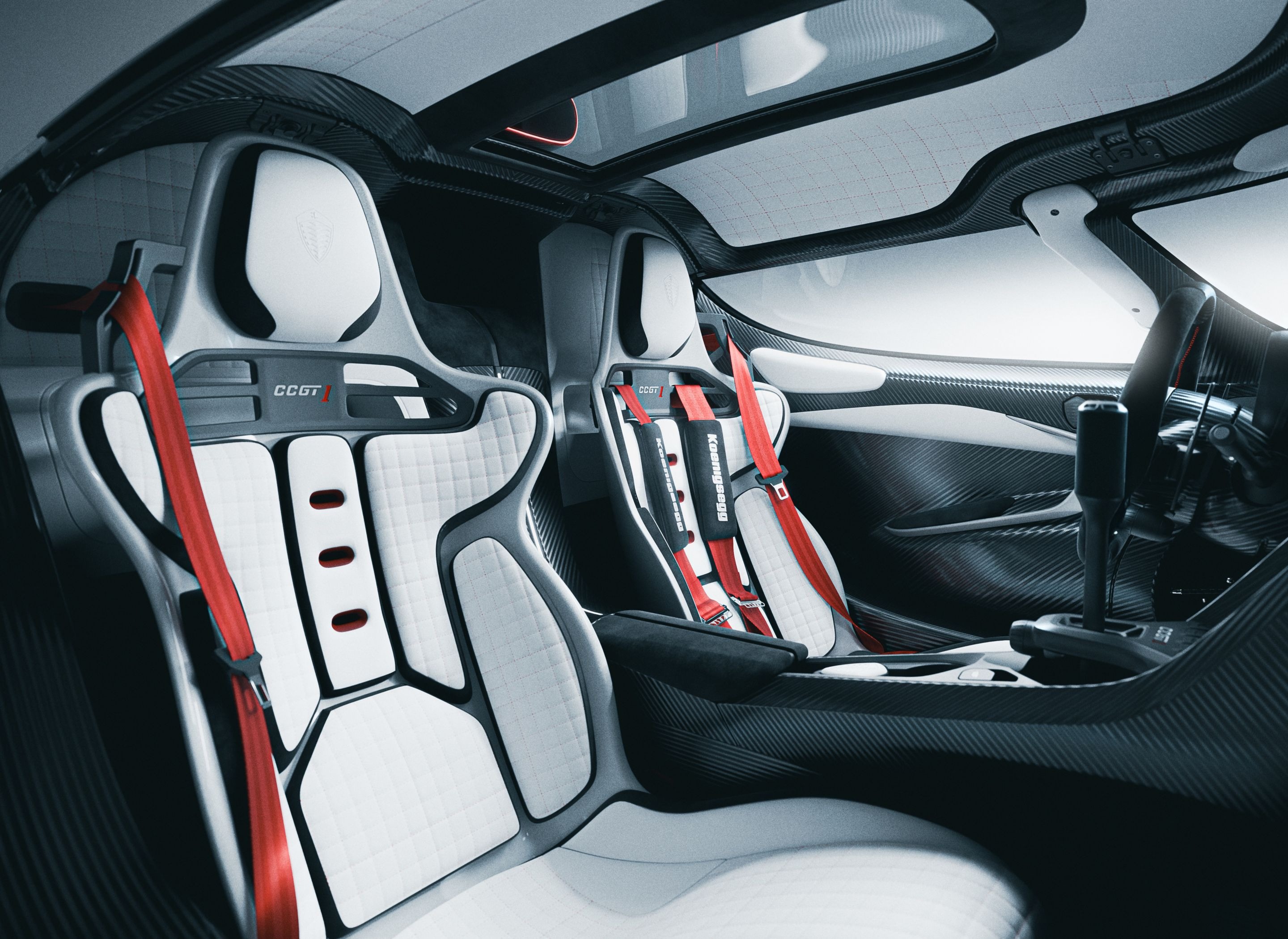
Drive goes through the nine-speed Light Speed Transmission with an electronic differential. Koenigsegg lists an optional H-pattern shifter, which on a car making 1,600 hp is a deliberately old-fashioned choice and the clearest sign of who the CCGT1 is aimed at.
The specification sheet, line by line
The structure is a carbon-fibre monocoque with aluminium honeycomb and integrated fuel tanks, quoted at 65,000 Nm per degree of torsional rigidity. The body is pre-impregnated carbon fibre, two doors, two seats, with a removable hardtop. Fuel capacity is 72 litres.
Suspension is by double wishbones front and rear, with inboard electronically adjustable springs and dampers, Triplex dampers at both ends and active rear-wheel steering. The turning circle is 11 metres. Ride height is 100 mm front and rear, or 105 mm with the lifting system.
Braking is carbon ceramic: 408 mm ventilated discs with six-piston calipers at the front, 390 mm with four-piston calipers at the rear, with Sport ABS. Wheels are 20 by 9.5 inches at the front on 275/35-20 Pirelli P Zero R tyres, and 21 by 12.5 inches at the rear on 335/30-21.
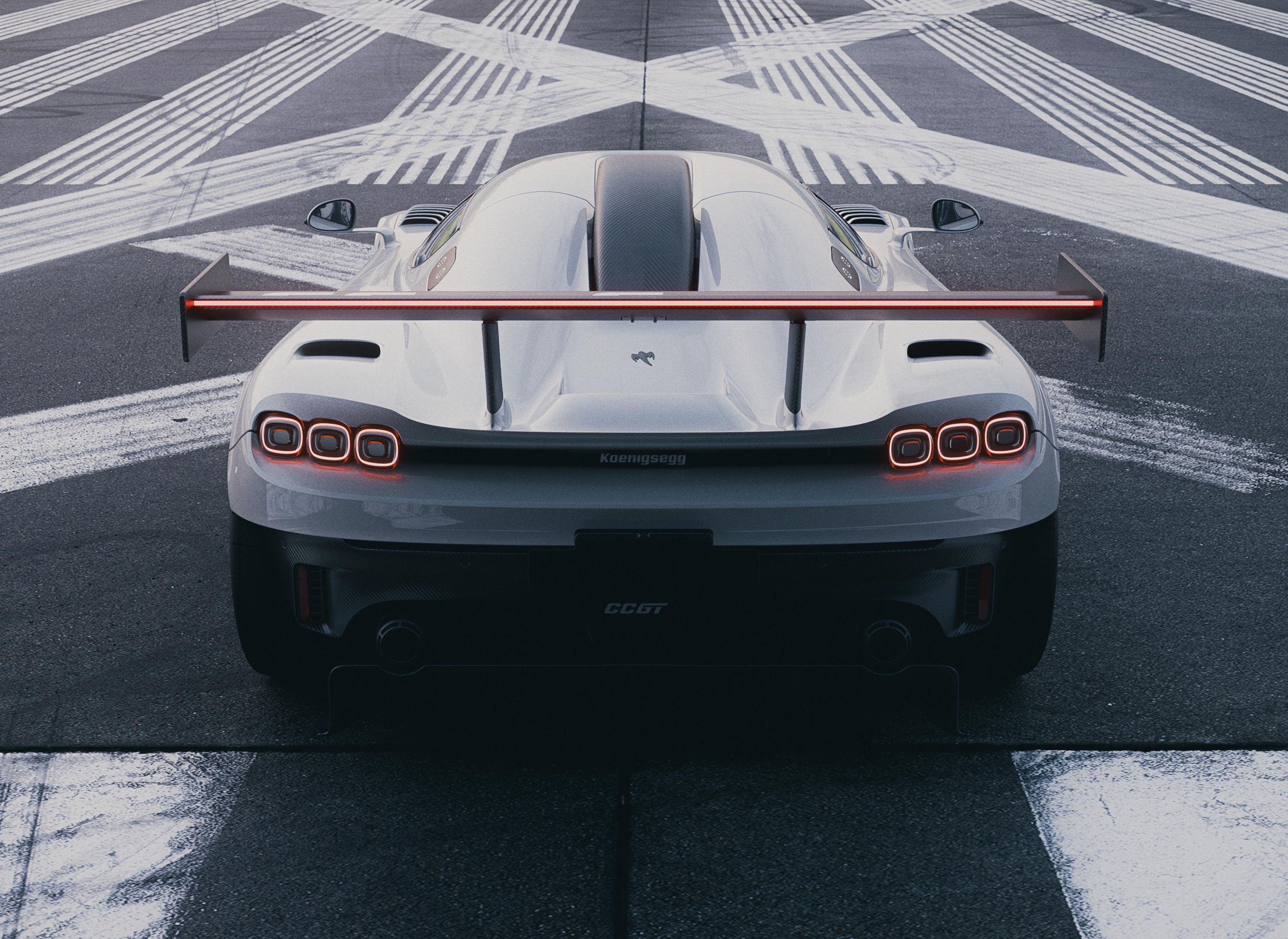
The car measures 4,478 mm long, 2,058 mm wide and 1,160 mm high on a 2,700 mm wheelbase. Aerodynamics are handled by an automatically adjustable rear wing, NACA ducts, side winglets and integrated diffusers, and Koenigsegg quotes a total of 800 kg of downforce at 250 km/h. That figure comes with a reference speed, which is what makes it usable.
The factory track package
Koenigsegg is offering its first factory-designed track package with the CCGT1. It covers racing seats, fire suppression and a further step in aerodynamics, so the road-legal car can be taken to a circuit specification without leaving the factory catalogue.
The part that is harder to buy elsewhere is the access. Owners who take the package also get invitations to CCGT1 track days run with factory support. Koenigsegg is selling a programme rather than an option box, which is the same logic Ferrari applies to the XX cars, transposed to a company that builds in tens rather than in hundreds.
The CCGT of 2007, built exactly once
Racing was in the plan from the start. While the first CC prototype was being developed, Christian von Koenigsegg studied the regulations of the Automobile Club de l'Ouest so the architecture could later carry a GT1 car. The CCGT was built in the gaps of the company's normal engineering and production schedule, and it took several years.
It was based on the CCR and borrowed parts from the newer CCX, its headlights most visibly. GT1 rules of the period capped width at two metres and required the cockpit to account for at least 70 per cent of the car's overall width, and the CCGT was drawn around those numbers: 4,293 mm long, 1,996 mm wide, 1,030 mm high, 50 mm of ground clearance and a 100-litre tank.
The engine was a naturally aspirated 5.0-litre 32-valve V8 producing 600 hp, the maximum the category allowed, with a dry sump, roller throttles, individual intake trumpets and Nira engine management. It drove through a Koenigsegg and Cima sequential magnesium transaxle with straight-cut gears and a dog-ring engagement, behind a 215 mm AP Racing twin-disc clutch.
The car weighed under 1,000 kg. GT1 imposed a 1,100 kg minimum, so Koenigsegg added roughly 100 kg of ballast and placed it where it wanted, which is the kind of advantage teams normally pay a great deal to obtain. Koenigsegg reported more than 600 kg of downforce from a flat floor, rear Venturi tunnels, a large fixed wing and a roof intake, at a drag coefficient of 0.297. It does not state the speed at which that downforce was measured, so it is not directly comparable with the 800 kg at 250 km/h quoted for the CCGT1.

Why the CCGT never raced
Shakedown testing had been running for two months when the ACO and the FIA changed the GT1 regulations. Carbon-fibre monocoques were prohibited, which disqualified the car Koenigsegg had just built, and the homologation requirement was raised from a total of 20 road cars over several years to 350 cars per year.
For a manufacturer whose entire output was measured in single figures per month, 350 a year was not a target to work towards. It was an exit. The programme stopped there, and the CCGT never started a race.
That is the fact the CCGT1 is built on. The tribute is not to a winning car, it is to a car that was finished, tested and then made ineligible by a rule change, and which stayed the only one of its kind because there was no longer any reason to build a second.
What a CCGT is worth: £3.3 million at Goodwood
The single 2007 CCGT has one public valuation, and it is a good one. Bonhams sold it on 14 July 2023 at the Goodwood Festival of Speed for £3,319,000, the top lot of a sale that totalled £10.65 million across the auction house's thirtieth anniversary event.
That result is the only real benchmark the model has. The car was never sold commercially as a road car and never competed, so there is no series, no race record and no second example to compare it with. An auction room set the number once, and it stands alone.
How much does the Koenigsegg CCGT1 cost?
Koenigsegg has not disclosed the price of the CCGT1, and nothing on its model page or its technical specification sheet mentions one. Anything circulating is an estimate, and it should be read as one.
On the evidence of the cars around it, the CCGT1 is estimated to start at around €4.5 million before taxes and options. The two useful reference points are the CC850, which shares its platform and sits in the region of €3.5 million to €3.7 million, and the Sadair's Spear, limited to 30 cars at €3.8 million before taxes. The CCGT1 adds a substantially redrawn body, 1,600 hp, 800 kg of downforce and a factory track programme on top of that base.
Two other figures are worth stating plainly because they are not published: Koenigsegg gives no kerb weight, no top speed and no acceleration time for the CCGT1. The 1,100 kg racing weight and the 600 hp belong to the CCGT of 2007, and carrying them across to the new car would describe a machine that does not exist.